



Implementing a Multi-Functional Audio System
By: Frances Putman
Marble Collegiate Church in New York City, organized in 1628, is the oldest Protestant church in North America. It was established as part of the Collegiate Reformed Protestant Dutch Church and has served under the Dutch, British and American flags over the past 378 years.
Sunday services are held in the same historic sanctuary--located at the corner of 5th Avenue and 29th Street, just five blocks from the Empire State Building--that has served the church since 1854.
In the 1930s, 1940s and 1950s, Marble was led by Dr. Norman Vincent Peale, an influential religious leader who authored The Power of Positive Thinking and was the co-publisher of the popular “Guideposts” magazine. In 1935, Peale launched a weekly radio broadcast called “The Art of Living,” which ran for 54 years. A television ministry, which Peale established in the 1950s, still flourishes today, with MarbleVision reaching hundreds of thousands of people throughout the world each week with the message of its current senior minister, Dr. Arthur Caliandro.
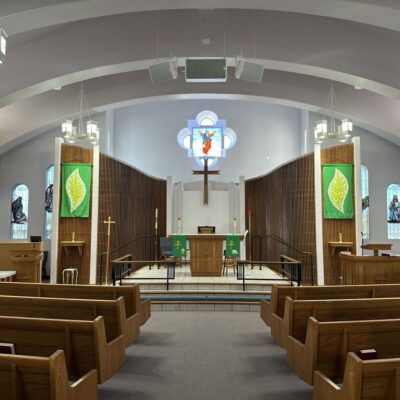
Technology can help a church span the globe, but it’s also important in reaching those who come in for weekly worship services. A few years ago, church leaders recognized the need to upgrade Marble’s audio system. One challenge was to incorporate new technology as unobtrusively as possible, taking great care to maintain the aesthetics of the historical sanctuary.
A second challenge was to create a triple-threat system to meet the varied audio needs of the church. It was important that messages from the pulpit not only be effectively heard throughout the sanctuary, but also fed to an overrun room in the church where services would be broadcast on plasma television monitors. Also, messages would be streamed to a third floor sound booth to be recorded for television and radio broadcasts, as well as possible CD and DVD productions.
Finally, the system needed to have an automatic component to be operational for programs other than Sunday morning or special services when a broadcast engineer is available.
“The system we created was multi-functional,” said Bob Pelepako, who along with his partner, Steve Minozzi, owns Monte Bros. Sound Systems, Inc., the company that completed the Marble audio project. “It addresses all the necessary functions.”
Pelepako and Minozzi, who have installed more than 1,500 sound systems in houses of worship, chose an Audia Biamp system as the platform.
“It’s basically a digital processor with open-ended architecture,” noted Minozzi. “We can design it any way we see fit.”
With a pre-set panel, the system can run on automatic mode, or switch to manual mode when an engineer is present. Microphones are split, with sound going out through the sanctuary, as well as to the overrun room and sound booth.
Two types of speakers were selected for the project—one made by CAMM (Custom Audio Manufacturing of Maine) and the other by Renkus-Heinz. The CAMM speakers were covered, then integrated into mahogany panels and placed beneath and around the balcony area. These small, powerful speakers easily blended into the design of the sanctuary.
The Renkus-Heinz speakers, which are conical-shaped and can be rotated up to 90 degrees, were installed horizontally beneath the organ pipes at the front of the worship space.
A 24-channel mixing board was installed in the console at the back of the church, and Crown amplifiers also were selected for the project. Two microphones installed at the pulpit allow the speaker to move around more freely, without affecting sound quality.
“The microphones are digitally programmed to track each other,” Pelepako said, noting the setup offers a much greater sound range, though only one mic at a time is in operation. If one mic happens to fail, the other serves as a backup.
The sound system installed by Monte Bros. also includes a hearing assistance program. Congregation members who wear hearing aids equipped with T-coils can pick up the sound through their own devices. Optional devices are available for those who can’t pick up the signal.
“It’s a very sophisticated system that required a lot of thought and planning,” said Minozzi.
For churches considering a new audio system, Pelepako suggested they look for a company that has experience working with churches, particularly of their own denomination. Some churches rely more on spoken word, while others focus more on music and congregation participation. That has an effect on the types of products that are best.
“Really, you need someone who understands the liturgy and the logistics,” he said.