



Home About CSP In Every Issue Blog Archives Buyer's Guide Media Guide e-News Subscribe Contact
Check Out The
February 2012 Supplement


The Chapel at CrossPoint
By: Frances Putman

For many years, The Chapel, a non-denominational church in the Buffalo, New York, area had been growing and expanding its ministries. The time had come to build a new facility, and the first step was selecting a site. 
  
Plans were underway for a new business park called CrossPoint in Amherst, just outside of Buffalo, and the developer was willing to give the church a good price on a parcel of land. One major advantage of the site was its proximity to additional parking. The developer would permit the church to use adjacent office parking for overflow. While other businesses would be more active through the week, the church would be the primary active occupant on Sundays and would have access to ample parking. That meant The Chapel could build and plan for expansion, while purchasing only 15 acres of property.
  
The challenge, however, was to design a church that would fit into the business park atmosphere. It was important to the developer that the church didn't look too much like a church. This was a challenge that sparked the interest of architect Richard Foo, AIA, one of the four partners of TurnerBatson Architects, a Birmingham, Alabama, firm.
  
"This rather cold restriction actually happens to match with The Chapel's doctrine and belief that Christianity is not a religion but rather a way of life, and therefore the building is not the church, but the people are," said Foo.
  
In an area of the country where approximately 85 percent of the Christian churches are Catholic, this evangelical Protestant church already was a bit different. It wasn't surprising that its worship facility would be different as well.
  
"For the design, we focused on the functional aspect—the flow of the people and the relationship of spaces in each department to the church itself," Foo said. "Basically, we let the form follow the function."
  
TurnerBatson's in-house 3-D animation capability allowed church leaders to visualize fully the exterior and interior elements of the new church building and to make modifications prior to the start of construction.
     
"Secular buildings must conform to certain standards of function, but religious buildings need to do more than that," said Foo. "They need to provide an environment that makes us feel humble in the presence of the Divine."
  
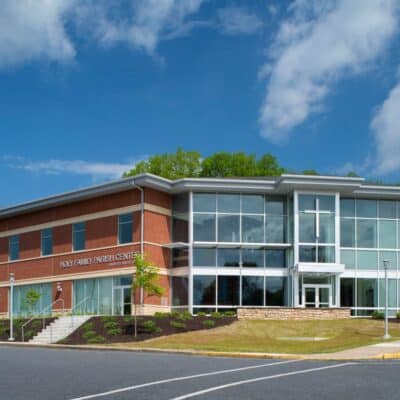
In addition to a cross that is incorporated into the building's façade, Foo and his team found symbolic ways to incorporate Christian tradition into the design. 
  
Three large glass sections on the entryway are symbolic of the Trinity. A key-shaped window in a private alcove off the main foyer is a reminder that Christ is the "key" to salvation. And, stone used from the ground up four feet on the brick exterior signifies that the church is built "on the rock."
  
"Later, the developer actually adopted this (stone design) in other office buildings that were built after The Chapel," noted Foo.
 
Architects at TurnerBatson designed a master plan for the church, with this initial facility being the first phase. Covering 125,000 square feet, the building includes a 2,800-seat worship space, with theater-style seating and a sloped floor. The stage area accommodates a 250-member choir and 30-member band or orchestra. A large storage area behind the stage connects with a loading dock. These elements were important because the church presents several special performances and musical presentations each year.
    
About 40 percent of the church's space is dedicated to the children's area—known as King's World—which includes children's classrooms, a large, colorful gathering area and a separate children's worship area for up to 250 children. This space also is used for puppets and drama presentations.
  
A space for adult Sunday School classes was intentionally not included, as the church sponsors small groups rather than traditional Sunday School classes. These small groups meet throughout the week--sometimes at the church, but more often in members' homes.
  
Worshippers come into the church through several entranceways into coatrooms. Since winters can get quite cold in Buffalo, it's important to have ample space for the storage of bulky outerware outside the worship center. 
  
The coatrooms lead into the main gathering area, where hot coffee is served and worshippers can talk and have fellowship. Foo liked the idea of using a skylight in this area, but it wasn't feasible because of the bitter cold temperatures in the winter. Instead, a simulated skylight with backlighting was added in the roof to give the bright and open feel of a traditional skylight. A private alcove off this main area offers a quiet place for private conversations not quite requiring a prayer room. Other spaces within the building include an administrative suite, music suite, small chapel, youth area and kitchen.
    
Once the church opened its doors at the new location, the name officially became The Chapel at CrossPoint, signifying its location in the CrossPoint complex. 
  
In a step that Foo believes was especially significant, the church got TurnerBatson involved in the project even before the land was selected for the new site. In fact, Foo and others on the TurnerBatson team were able to give advice on site selection.
  
"My advice to church leaders considering a similar building project is to identify a good architect, one who knows and understands churches (and their particular needs)," he said. 
  
It's a little unusual for a church to look 900 miles away for an architect, but that's just what leaders at The Chapel at CrossPoint did. One of the staff members had previously served at a church in the Atlanta area and was familiar with the work of TurnerBatson.  The firm was contacted and ultimately awarded the contract.
  
The right architect is important, Foo said, to guide the church in analyzing and evaluating its strengths and options, as well as the wisest stewardship of resources before launching an expensive capital building program.
  
"You've got to understand that a church will grow, and it's important to design it in a way so it can grow in an orderly manner," Foo added.
  
TurnerBatson Architects, www.turnerbatson.com, has been providing full service architectural services to churches since 1924.  The firm has a project portfolio including more than 800 churches, with projects ranging from renovations and additions to complete relocations. 

Fast Facts

Church: The Chapel at CrossPoint
Affiliation: Non-denominational
Location: Amherst, New York, just outside Buffalo
Weekly Attendance: Approximately 3,000 to 4,000 in two Sunday morning worship services
Project: Build a new worship facility for this growing church, which needed more space for the expansion of ministries
Size: 125,000 square feet
Cost: $17 million for construction; $20 million for the total project
Construction Time: 18 months
Challenge: The church was the first facility built in a new business park. Covenants in place restricted the design, as it was important that the facility blend with other buildings that would become part of the development. Mostly, the church couldn't look like too much like a church. That meant no traditional design elements.
Solution: The church was designed to fit into the environment, with a look unlike most other European-style, Gothic-designed churches in the surrounding communities. From a distance, the facility could appear to be an office building. Materials like stone, glass, brick and dryvit are similar to those used in other facilities in the business park. However, special care was taken to incorporate a Christian feel into the design.   


Voice Broadcasting

©Copyright 2012 Religious Product News
Religious Product News