




Home About CSP In Every Issue Blog Archives Buyer's Guide Media Guide e-News Subscribe Contact
Check Out The
February 2012 Supplement


Audio/Video Overview


In our annual focus on church audio and video issues and trends, we've identified some of your top concerns and have addressed them in the following pages. A/V technology continues to evolve in churches, and we're committed to bringing you the latest news, trends, and techniques for making sure that you're taking full advantage of the newest technology to deliver your message each week.

Here are some great "take-aways" from this section.

Choir Microphones
Since you must be able to pick up voices that are 6 to 10 feet away, you will want to use a condenser microphone for a choir instead of a dynamic microphone. Condensers are usually more expensive than dynamics, but they have a flatter frequency response and much greater output than dynamics (usually 10 – 15 dB higher output), giving greater performance from a distance. An added benefit is that condenser microphones will produce a higher signal-to-noise ratio (lower hiss or noise) and a better dynamic range.

Digital Projection
It is important that you assemble a visual media team suited for this ministry, which is not unlike any other ministry in your church. It requires much more than a state-of-the-art projector; it requires a dedicated team of people. Also, take special care in choosing the right hardware and software to run this system. A well-defined plan will reduce or eliminate problems as well as save you time and money in the future. Be sure to develop a reasonable graphics budget for your system. It is surprising how many churches will spend thousands of dollars on good projector systems and then display poor quality, distracting graphics through them.

Sound Booth Construction
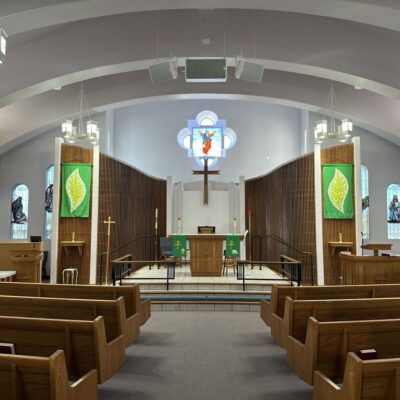
Sound booth operators should hear what the congregation hears. A booth located out of direct line-of-sight of the main speakers will only receive sounds reflected off the walls and the floor.  This reflection causes sound to be perceived as softer and muddy. This results in the sound operator increasing the volume in the main speakers so they can hear, thereby blasting a higher-than-necessary level of volume into the majority of the congregation. Additionally, sound booth operators should see all areas of the pulpit (stage) area. 

In closing, don't forget to check out our roundup of the latest and greatest audio and video products for your church at the end of this special section.


Voice Broadcasting

©Copyright 2012 Religious Product News
Religious Product News