




Home About CSP In Every Issue Blog Archives Buyer's Guide Media Guide e-News Subscribe Contact
Check Out The
February 2012 Supplement


Acoustical Myths and Realities
By: Nick Colleran

Over the years, I have discovered many acoustic truths that turned out to be myths, at one time going to the trouble and expense of testing egg cartons in a certified acoustical testing facility just to set to rest the myth that they were as good as acoustical foam. They weren’t. This article will focus on the folklore of acoustics as it relates to traditional and contemporary worship spaces.

Myth: My acoustical materials meet fire code.
The real question is this: Do the materials meet code for their intended purpose? A carpet material may have reasonable sound absorption properties when mounted on the wall, like the orange shag carpet found on studio walls in the disco era. However, what passes muster mounted on the flat horizontal surface of a floor may exhibit totally different characteristics when mounted on a vertical surface, such as a wall where oxygen flows upward toward the ceiling. It can be even more troublesome in room corners where there is more updraft. Before going to the carpet store and getting a deal on remnants, it is essential to check both vertical burn and corner burn characteristics to be sure the material passes code for its intended use.

The same holds true for the polyurethane acoustical foams that rose to popularity as a studio treatment in the late 1970s. Most are Class C, and a few meet Class B. Usually Class A is required for large occupancy rooms. Foam may be suitable for small studio areas, but probably not in a high-rise building. In no circumstance should packing or bedding foam be used as a room treatment. It is most often polyether foam, not particularly good for acoustics but a great source for fueling flames. Your mattress foam may meet code for a bed, but it was never intended as a wall covering!

Some acoustical products have obscure ratings like FMVSS-302. This is a Federal Motor Vehicle (fire) Safety Standard. While this is valid information, it should not imply approval for interior building construction. As a point of comparison, it is okay to have 30 gallons of gasoline in your SUV, but not in an auditorium or church.

While all of this information has value, the term “fireproof” may still be illusive. Flammability tests will help in determining what material is suitable for a given use. However, another question which can be of equal or greater concern would be “How much smoke is produced?”

Myth: Sound absorbers stop sound and noise penetration.
This may be slightly true. Any material with mass will block some sound and absorbers may reduce intensity within the room, thereby lowering the level of sound available to pass through the wall. However, the short answer is no! Blocking sound requires materials that are heavy, dense and massive. (Interior materials that block traffic noise into the sanctuary or crying from the nursery are usually gypsum, drywall or sheetrock.) Two layers work well. For many years, recording studios used two layers of 5/8 inch “green board” (a heavy, denser drywall) to accomplish sound blocking. In later years, a layer of acoustical lead was added to the mix (certainly heavy dense and massive, but not particularly easy to handle). More recently, mass loaded vinyl sound barrier, a material that is heavy as lead but more pliable, is sandwiched between 5/8 inch and 1/2 inch sheetrock to produce the same result. The different materials offer an advantage since sound must change speed as it changes media, and, much like a runner jumping hurdles, it wears itself out, losing energy and intensity or loudness. While not a “blocker,” adding absorption to trap air within a wall will prevent the wall from acting like a drum. Hitting the wall should produce a “thud” rather than a “boing.”

Myth: Doubling material thickness (or quantity) doubles its performance.
This is not so whether speaking of penetration - Sound Transmission Class (STC), or absorption - Noise Reduction Coefficient (NRC). Doubling material thickness does not double STC or absorption. Doubling absorption thickness won’t halve the room’s reverberation time (RT60). To halve the reverberation time of a room will require one quantity of material. Bringing the reverb time down to one-quarter will require the same amount again. It is not linear but rather a geometric progression; each time the reverberation time is cut in half it requires the same quantity of material. Translated to dollars, a reasonable improvement costs one amount; polishing the performance to ideal, will double the cost. The first half and the next quarter are equal.

Myth: An absorber (or barrier) behind a microphone blocks interference.
This has some truth acoustically, but most directional microphones rely on rear and side ports to create their cardioid pattern by allowing sound to enter through these ports and create destructive interference to reject sound from behind the microphone. Materials placed near or on the microphone interfere with this operation and cause the microphone to become omni-directional, picking up more stray room noise and becoming susceptible to feedback with live monitors. This effect can also be heard when a performer holds a microphone in a manner that blocks the ports.

Myth: Bass traps eliminate bass.
The term bass trap is counterintuitive. Trapping bass allows low frequencies to be heard by providing them an acoustical “open window” to develop rather than canceling themselves when they reflect back out-of-phase with their hills (forward motion) meeting their valleys (backward motion). This leads nicely to the next point in our list.

Myth: I can fix the acoustics with my sound system’s equalizer.
What is true for bass applies across the sound spectrum: increasing the level of a specific frequency of sound within a room will also increase the level of its out-of-phase reflection. Boosting sound by 3, 6, or 12 dB will also boost the interference by an equal amount producing a zero sum. That is, +3 added to –3 equals zero as does +12 and –12 equal 0.

Myth: Anything will sound good in a well-designed room
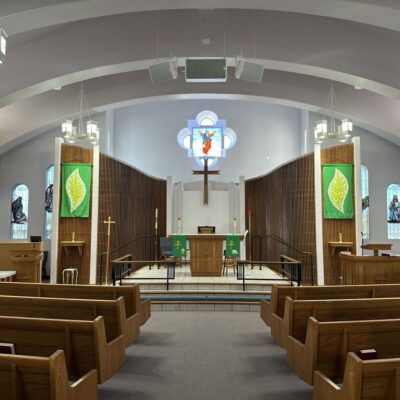
While it may be true that a properly designed control room should allow recorded material to be judged without the positive or negative influences of the listening environment, the same does not hold true for a sanctuary or performance space. One size does not fit all. A traditional room for acoustic instruments can easily be overloaded by a modern praise band. Whereas an acoustic guitar may fade before its sound hits the rear wall, a guitar amplifier will produce sound that reflects back and keeps going and going! A room designed for high energy sound with much absorption added to control reflections will be a disaster for a service that includes unaccompanied congregational singing where reflections create the shower-stall effect by producing the reverberation necessary to enhance blend and encourage singing out, without fear of being singled out, if a bad note escapes. As with fire code concerns on where material is used, acoustical concerns focus on what is the intended use and type of performance.

Myth: Sealing a room keeps the sound in.
Actually, it may get worse if the walls are spaced to cancel certain ranges such as the bass, but thin enough to allow the bass, that isn’t heard inside, to pass though to the neighbors. (There are other paths to neighbors like common water and sewer that can cause problems blocks away!) If you can’t hear the sound, turning it up won’t help inside the room, but it will enhance the problem outside, down the hall and across the street.

Myth: Seeing is believing.
This could go either way, yes or no, but never bet that what you see is what you hear. Listen with your ears, not your eyes. Seeing is not hearing. What’s behind the curtain (or acoustical fabric)? It’s the grapevine in reverse: Believe what you hear, not what you see, especially if it’s a movie or on TV. If you observe the singer holding the microphone backwards or hear a Fender sound from a Gibson guitar, and hear synthesized horns while the performers hold real ones, chances are that the performance space you see is not the one you hear, and not a design to copy to achieve that sound.

Myth: Complete the sound system first.
Choosing a full sound system in lieu of acoustics for budget is a bad choice. You cannot hear what you paid for if the sound system feeds back due to reverberance or if the room modes cancel certain frequencies! While a large system may leave little to devote to acoustics, allocating the budget to acoustics first will save unnecessary expense in trying to overcome bad acoustics with electronics.

Nick Colleran is the past president of the Society of Professional Audio Recording Services, the past president of the Virginia Productions Services Association, a current member of the Acoustical Society of America, and a former recording artist and recording engineer. He is a principal of Acoustics First Corporation, www.acousticsfirst.com, which manufactures and distributes products to control sound and eliminate noise in commercial and industrial applications worldwide.

Sidebar
Making Green Sense of Green Design
By Marlayna Glynn Brown

No longer using the word “green” to denote envy, inexperience, ignorance, or illness, the architectural world has created the positive “green building movement.” At the forefront of new building design and construction, “green design” is the design of buildings with ecological principals in mind, and it is quickly becoming increasingly important in our economy. Acoustic, audio-visual, and telecom consultants are developing important and money-saving contributions of their own toward the green building movement.

As the economy shifts, and everyone looks for ways to reduce consumption through energy efficiency and recycling, buildings are not often viewed as vehicles for climate change. But when one considers that buildings are responsible for 40 percent of carbon dioxide emissions due to energy use, water consumption, and other operational issues, it is easy to see how the green building movement makes both financial and ecological sense.

Many municipalities—including Austin, Atlanta, New York, and Chicago—are now requiring that all new city buildings become “LEED certified.” LEED is the US Green Building Council’s (USGBC) Leadership in Energy and Environment Design’s rating system. On their Web site, www.usgbc.com, the USGBC defines LEED as “the nationally accepted benchmark for the design, construction, and operation of high performance green buildings. LEED gives building owners and operators the tools they need to have an immediate and measurable impact on their buildings’ performance. LEED promotes a whole-building approach to sustainability by recognizing performance in five key areas of human and environmental health: sustainable site development, water savings, energy efficiency, materials selection, and indoor environmental quality.”

So, how does this movement impact the church that is preparing to build a new facility?

Though private buildings are not at this time required to become LEED certified, it will not be surprising if this changes in the not-too-distant future. When considering new construction, the architect and owner should keep in mind the long-term investments for the church owner if basic green principles are taken into consideration during the initial design process.

Utilizing green building principles can benefit church management in several fiscally important ways. The owner will reap long-term financial benefits in saved costs resulting from the use of energy-efficient products. The building’s resale value can be increased due to its energy efficiency and environmentally friendly design. And, designing a building to be an environmentally good neighbor to the community may just help the church attract new members.

An acoustics, telecom and audio-visual designer trained in LEED principles can make important contributions toward the green design of a church. By specifying the use of a videoconferencing system, church leaders can save time and money on travel, thereby reducing carbon emissions. A consultant can recommend recycled materials when designing the acoustical environment of various rooms. By keeping a constant eye toward reduced energy consumption, an experienced and well-informed AV consultant can recommend the use of specific products and systems that enable the church to substantially lower operating costs.

Though audio-visual components are not yet a part of the actual LEED certification process, in all likelihood, this will change at some point in the future. In the meantime, church owners and architects are wise to consider the important impact their building can have not just in the spiritual sense of the world, but in the environmental sense as well.

Marlayna Glynn Brown is the director of business development for Dickensheets Design Associates, www.dickensheets.com, in Austin, Texas.


Voice Broadcasting

©Copyright 2012 Religious Product News
Religious Product News