




![]() |
||||||||||||||||||||||||||||||||||||
|
Furnishing Your Sanctuary
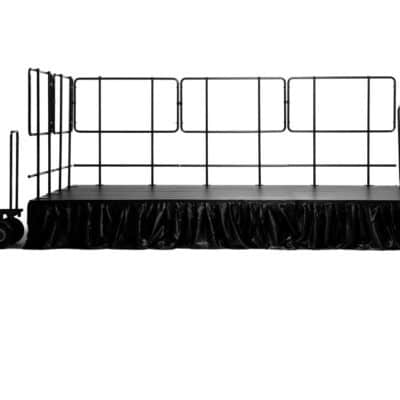
By: JJ Astor All the world's a stage, Shakespeare wrote. Yes, but how do you get stages into your chapel? And, do you really want stages or choral risers? What sizes do they come in? With carpets or without? Folding or mobile? To skirt or not to skirt? Those are the questions. Or, at least some of them. And, what's a stage in a chapel without a podium or lectern? Are all podiums created equal? If not, how do they differ? And what do they cost? Those, too, are the questions. Unfortunately, for all his brilliance, Shakespeare did not pen guidelines for furnishing the modern sanctuary. What's a post-Elizabethan person to do? Fortunately, we can to fill in blanks that Sir William did not. Risers vs. Stages If you have a chorus or band, you might want to consider a riser. They are made specifically for choruses and bands. They are shallow platforms typically 18" deep and 8' long that can be connected to each other. The most common arrangement is three rows wide and two to four levels high (i.e., they go back in ever-increasing heights of about 8" with the ground platform being 8" off the ground, the next level back 16" off the ground, the next 24" and the fourth level, if you choose, 32" high). Risers can be carpeted or uncarpeted, tapered or straight (tapered means that they connect at slight angles and form a "U") and with or without steps (sold separately). You also have to decide if you want them with or without guardrails; however, for obvious safety reasons, guardrails are strongly recommended. A single choral riser platform (for example, 18" deep by 8' long) normally fits four to five adults or six children. So, if, for instance, you order a 3-wide and 2-high choral riser a total of six connected platforms you will accommodate 24 adults or 36 children on the average. Band risers are deeper than 18" usually 36" to 48" deep allowing the band members to sit on chairs (24" for the chair, 12" for the person's feet, with an optional 12" for an aisle). Stages Let You Be More Flexible In these situations, you need a stage. Stages are more flexible than risers. They can double as a place to put your choral singers and band, or they can be used for numerous other purposes. They, too, can be carpeted or uncarpeted, with or without guardrails, and with or without steps. Size Matters They typically come standard with the ability to connect to each other. This gives you great flexibility to make your staged area as large as you want and in a great variety of shapes. For instance, you can connect them together to create one large area in the shape of a rectangle or square. Or, you can put them in the form of a "T" to create a type of runway in the front. Mobile or Portable? At the very least, a stage or riser should be portable. This means that the legs can be folded underneath the platform, allowing the riser or stage to be transported from room to room or into a storage area. Most risers or stages are sold with optional caddies that allow you to stack them on top and roll the whole lot to storage or another room. Beyond portability, some risers and stages can be mobile. "Mobile" means they have wheels built into them. Not only can you fold them up, but, once folded, you can roll them to where you need without a caddy. Although mobility has its advantages, these units tend to be more expensive. You have to determine if the extra expense is worth the convenience of not needing a caddy. In addition, some mobile stages or risers can be bulkier; the wheels add extra dimension to the piece. Also, although the best mobile stages/risers are made well, nevertheless, as the saying goes, stuff happens. If the wheel breaks or the bar that holds it gets bent, it can be very costly to fix, if even possible at all. Mobile stages are a great convenience and something worth considering. However, statistically, most people find portable stages and rises perfectly adequate. To Skirt or Not to Skirt Quality skirting today comes standard backed with Velcro on the skirting itself, as well as a separate strip of adhesive-backed Velcro to attach to the rim of the stage. Once you run the adhesive-backed strip around the stage, you can then Velcro the skirting to it easily and remove it just as easily if and when you decide to move your stages/risers. It seems like most people choose black for their skirting, but they come in a whole host of colors. Ask your supplier for a swatch of possible colors. Skirting is an inexpensive way to make your stage or riser look great and professional. Podiums & Lecterns The classic podium is made of wood, but clear, see-through acrylic lecterns are becoming more and more common. Simple wood lecterns can be found for less than $100 (including shipping!), while more expensive ones can cost $500 to $1,000 or more. The good news is that you can get a really attractive and functional one for well under $1,000. Furthermore, many podiums and lecterns come with a built-in sound system (this doesn't apply to acrylic versions). Typically, the built-in sound systems can accommodate audiences of 50 to 3,000 people. The more powerful the built-in amplifier, the more people you will reach and the more you will pay. Many such "sound" lecterns come standard with one or two or microphones (e.g., handheld, headset and tie-clip mics), plus an option for wireless microphones. If all the world is a stage, then your sanctuary certainly needs to be sufficiently equipped with the right type of stage (or riser) and podium. How you furnish your sanctuary can speak volumes about your message without a word even being said. JJ Astor writes professionally on a broad range of topics, including furniture articles on the Hertz Furniture Web site, www.hertzfurniture.com. He has more than six years of experience as a sales representative and regional sales manager for Hertz. |
|
||||||||||||||||||||||||||||||||||
|
||||||||||||||||||||||||||||||||||||
|
For Christian School Products, Reviews And Resources Visit The Christian School Products Website |