



Church Lighting
By: Andy Manning
Here are the answers to some of the most frequently asked questions by church leaders about lighting for their worship facilities.
Q: The light levels in our church are too low. Where do we start?
A: Start with maximizing the output of your current lighting. First, make sure your existing fixtures have the correct lamps in them. You may find that regular light bulbs have been installed in place of specialized reflector flood lamps (designed to provide downlight). If you are unsure exactly what kind of lamps or what wattages should be in your fixture, consult the manufacturer or a local electrician. A good cleaning of the glass or acrylic diffusers will also help!
Q: We have made sure out fixtures are operating properly, but there's still not enough light. Now what?
A: Now it's time to plan your lighting upgrade. Churches should consult with a lighting design professional or knowledgeable architect or electrical engineering firm. Professionals bring a wealth of knowledge to the table, including new lamp and fixture technologies, reputation of manufacturers, and a disciplined approach. In the hands of a trained professional, lighting can accomplish amazing things: make the space look larger or smaller, communicate a joyous or somber tone, draw attention to important elements within the church, and much more. Even a few small, inexpensive fixtures placed in the appropriate locations can have a big impact. Professionals will be a necessity if you want help navigating the technically complex world of theatrical lighting and control systems or do a lot of multimedia productions.
If you're on a tight budget like most churches, you should also investigate the free advice and services that many lighting manufacturers offer. Be sure to choose a manufacturer with a good reputation and experience in accommodating the special needs of churches. Manufacturers are usually represented by independent lighting sales representatives in your area, and they can helpful in determining your needs.
Q: What elements are critical to a good lighting design?
A: Churches should be conscious of a number of things when deciding on a lighting design.
First, what type of lighting fixture complements the design of the architecture? Should the fixtures be ornate and decorative units that work in harmony with the space, or more utilitarian fixtures that don't call attention to themselves?
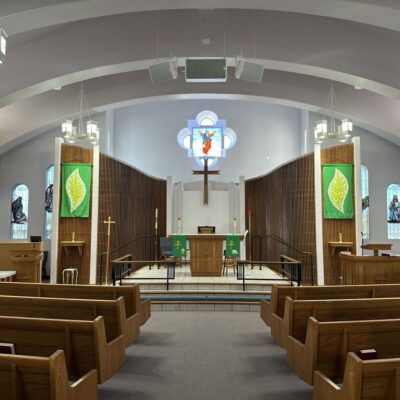
Second, churches must consider the different types of light needed. Most churches require direct light above the seating area for reading, indirect light to brighten the space above and avoid the "cave" effect a dark ceiling can give, and accent light to draw attention to the pulpit, altar, or other important areas. The combination of these elements is unique to every church, and their location, mounting height, and lamp type dictate a successful lighting design.
It is also important to consider the different elements of a worship service and how they should be lit. Sophisticated control systems offer preset "scenes" so that different lighting effects can be accessed at the touch of a button.
Remember that more light is not necessarily better light. Glare is a significant concern, and it can be especially problematic in a worship setting. A good lighting design includes properly shielded fixtures that produce comfortable illumination.
Q: How difficult is it to redesign lighting in a currently existing building?
A: It all depends on the building and the results desired. Older churches often require wiring to be replaced and conduit to be run to new locations. Other buildings can achieve remarkable results simply by replacing existing fixtures with new ones of better quality. Again, an architect, electrical engineer and lighting designer can spot troublesome areas before the project begins.
Q: What kind of energy-efficient lighting technologies are best for churches?
Compact fluorescent lamps are a good fit for churches since they are widely available and offer much longer lamp life and consume far less electricity than standard incandescent sources. Most fluorescent lamps are also available in warm color temperatures for more pleasing results in a church setting. Dimming compact fluorescents can be expensive, however, so make sure you need this capability before diving into the world of lighting control systems.
Metal halide lamps also offer high performance and reduced energy use, but they are also difficult to dim and can color shift over time. LED lighting is a fast-improving technology, but it is best suited for specific applications where small size and ultra-low wattages are required (step lights are a good example).
The best solution for many churches is a combination of fluorescent lamps inside the fixture with an incandescent reflector lamp as a downlight. This arrangement balances energy efficiency and maintenance with overall performance and ability to control the lamps.
Andy Manning is president of Manning Lighting, www.manningltg.com.