



Home About CSP In Every Issue Blog Archives Buyer's Guide Media Guide e-News Subscribe Contact
NACB Winner 2010
Check Out The
September 2010 Supplement
August 2010 Supplement


Projectors for Houses of Worship
By: John Glad

Considering your projector options? Keep these specification targets and features in mind while you search.

If a picture says 1,000 words, a video image does much better. Houses of worship are increasingly turning to video systems to display testimonials, a magnified image (IMAG) of the pastor and choir, song lyrics, and Bible verses. Integrating video into worship services means seeking out a display that is large and bright enough to reach—and captivate—hundreds of congregation members at once. For most sanctuaries, the obvious choice is a projector.

But, where do you begin? The market currently offers projector models that range in price from hundreds of dollars to six figures. Few churches have unlimited funds, and most congregations will want to hew much closer to the former figure than to the latter. Depending on the sanctuary size and the video system involved, some features and specification targets will be must-haves, while others will be unnecessary. When considering a projector for your church, it's important to determine which is which.

Brightness Requirements
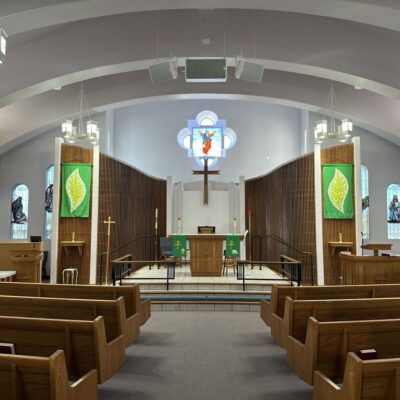
Perhaps the first projector metric to consider is brightness. A projector's brightness is expressed in terms of ANSI lumens, which reflects the results of a standardized procedure that measures its light output. Every sanctuary is different, of course. Some are immense; some are more intimate. Some are windowless, and, in many, sunlight streams through stained-glass windows. There is, then, no one-size-fits-all solution for projector brightness, but most sanctuaries' requirements will fall into a general range.

Most churches are large and have ambient light, so they need high-brightness projectors. The brighter the projector, the larger the image you can project onto a screen. A brightness at around 4,500 to 5,000 lumens is ideal for most sanctuaries. Even for churches that have a lot of stained-glass windows or ambient light, 5,000 lumens can meet their needs.

But as noted, every sanctuary is different. To determine your sanctuary's exact brightness needs, consult a systems integrator or A/V dealer who has experience designing video systems for houses of worship.

Lenses
Every projector has a lens, but some can accept interchangeable lenses. This is an important feature for many churches, especially those that are trying to preserve their sanctuary aesthetics by keeping gear out of sight. Install a projector in the back of the room, or underneath the balcony, and it might need a long-throw lens to reach the screen adequately. This can become moot, however, for a sanctuary that can install a projector in a room behind the altar, in a rear-projection configuration. However, most older churches don't want to deviate from the architectural design that they have been seeing for the last 20 or 30 years. What they have is a powered drop-down screen. For these churches, front projection—and from a considerable distance—is the answer.

Lens shift is another feature that can be important for installation environments such as a house of worship. This feature mainly helps installers; if a projector's lens can be shifted, it means that there is some margin for error for properly lining up the image and the screen.

Control
Besides creating a bright image that your whole congregation can view, perhaps the most important aspect of a projector is the level of control that it offers. In any church service, downtime is something to be avoided at all costs. For that reason, a simple projector feature such as power-up time is something to consider.

The next control issue is sending the proper video sources to your projector. Having a lot of inputs on the projector is important, because you're probably going to be plugging in multiple sources: DVD players, televisions, cameras, computers, etc. Connections to look out for include RGB, BNC, S-Video, composite, and component. As your connection needs might change over time—say, if you acquire another camera—be sure to anticipate future needs.

If you don't have a sophisticated video control system, you are not alone. Many congregations rely on hard-wired remotes to control projector functions.

Maintenance
Like any piece of gear, projector components don't last forever. Lamps last about 2,000 hours for LCD models and only about 1,000 hours for DLP models. Filters, which catch dust and keep it away from the optical system, also need to be changed on a fairly predictable schedule. Cleaning the filter is no small task when the projector is mounted to the ceiling.

Hybrid filters extend that schedule by a significant factor. The hybrid filter allows the church about 2,000 hours before cleaning the filter. That's a huge thing; a typical projector needs attention every 400 or 500 hours. It's no accident that a hybrid filter extends the filter's up-time to put it in line with lamp life. If you have to borrow or rent a lift to service the projector, you might as well kill two birds with one stone.

Once you are up there servicing the projector, access can either be difficult or very simple, depending on the projector model. Look for a projector that allows access via the side. You don't want to have to unmount a projector to service it from the top of the unit.

Down the Road
As you might have noticed from a trip to the local Best Buy (if not your own living room), the world is going widescreen. In your sanctuary, however, chances are good that your camera is still capturing images with the 4:3 aspect ratio. But, what about a few years down the road? It might be time to consider widescreen projection, especially now that almost all new laptops display a native 16:10 aspect ratio (matching the aspect ratio of many widescreen projectors).

Hard-wired remotes are good enough for many churches, but a sophisticated video system calls for a more sophisticated control mechanism. Most projectors offer RS-232 control, which allows them to be controlled via a video switcher.

As with any significant purchase, it's important to consider not only how it will be used today, but how it might be used a few years down the road. When you consult your dealer or systems integrator to discuss your projection needs, keep in mind both your present and future display goals. Congregations grow, and needs change.

John Glad is the product manager for Hitachi Home Electronics (America), Inc. Business Group, www.hitachi.us.