



This article originally appeared in the June 2008 issue.
By Larisa Waya
Larisa Waya is the founder/owner of Clergy Couture, which develops and produces a system of dressing for professional clergy women and provides consulting in clergy fashion, www.ClergyCouture.com.
As the pastor of your church, you are standing in front of the congregation, ready to preach. Hundreds of eyes are turned toward the messenger. But even before you speak a word, the message has already been transmitted through your appearance.
What kind of message?
First is the theological statement made through your vestments with religious symbols and liturgical colors. Second is the aesthetic statement made through your body language, your grooming, and your clothing.
Therefore, both theological and aesthetic statements are sent through your physical appearance even before you utter a word. The communication between pastor and congregation is happening on two levels: the visible and the invisible.
Your personal spirituality radiates from the inside out. The opposite of the spiritual is not necessarily the physical or the material, but rather unbalance of the spiritual and the physical. When there is incompatibility between your external being and your internal being, it creates unbalance and disharmony.
The pastor is an agent of God’s wide love working toward ultimate balance and perfect harmony. On the invisible plane, the pastor radiates a feeling of the balance and harmony of his or her internal and external being. The congregation may not respond to it articulately, but they will definitely recognize or perceive it with their hearts.
There is no doubt that what you are wearing speaks before you do. Hence the logical question: “What is the best robe?” The best robe is the one that most becomes you.
Before you search for your clergy apparel, pause for a moment and think about what message you want to communicate in the apparel. How does it reflect who you are? You are a unique preacher and must develop your own personal style, just as each of us develops our own handwriting. Your unique image is supposed to be reflected through the apparel you are wearing. Contemporary clergy apparel offers rich diversity to fit every clergy personality.
How then do you orient yourself in the world of clergy fashion?
Clergy robes stretch between two major poles: simplicity and glamour. When you search for clergy apparel, let me guide you through three major steps.
- Color and style
Ask yourself the following questions:
* For what purpose am I going to wear the robe or vestment?
* How is it going to reflect my theology?
* How is it going to express my self-identity?
* What is the identity of the congregation? (theology, ethnicity, denomination, dress code, etc.)
Always remember that what you wear is an important tool of communication with your congregation.
- Quality of the material
Ask yourself the following questions:
* How warm or how cool will I feel in the robe?
* If it will be worn indoors, is there air conditioning?
* If it will be worn outdoors, what is the season? Cold or hot?
Your personal body temperature will advise you on choosing between artificial and natural fibers. Each category has advantages and disadvantages. Artificial materials (polyester, acetate, brocade, satin) require little maintenance, but they could be too warm in a hot environment and create static in a cold environment. On the other hand, natural fibers (linen, cotton, wool, tencel, natural silk) need more attention to avoid wrinkles, but they are “breathable” and can adjust body temperature to the environment.
Considering all of these nuances, clergy robes present a variety of blended materials (linen/poly, cotton/poly, wool/rayon, etc.) This may help you decide about lining options. Lined robes may hang and drape better, but they also have an additional layer of material (in most cases it is 100% polyester, which may feel warm in hot weather). And, lined garments cost more money.
- Functional details
Ask yourself the following questions:
* How long do I want my robe to be? Floor length or ankle length?
(Think of your personal taste. Also remember the church architecture—do you need to climb steps during worship?)
* How long do I want my sleeves? What shape?
(Think how it will work when you serve communion, do baptism, or give benediction.)
* What kind of neckline do I want? What is the most comfortable? Will I wear a dickie underneath or a clergy shirt with collar or shirt and tie?
(Imagine how it will look on you.)
* How do I like my garment to be fastened?
(Zipper, buttons, snaps, Velcro, by wrapping or tying?)
* How fitted or how loose do I want my robe?
(Think if you are going to wear layers underneath, or you may prefer a tailored look. Keep in mind that with a loose or fitted robe, you can “add” or “lose” several pounds.)
* Do I need pockets and a microphone hole? (It’s all about your preferences.)
Eventually, you also may ask yourself how many robes you need. When you start building your clergy wardrobe, you need two basic pieces: solid white and solid black robes. They will carry you through the whole liturgical calendar.
Contemporary clergy apparel is functional and capable of self-expression. It offers a wide variety of preaching robes, albs, clergy jackets, shirts, blouses, skirts, dickies, and stoles.
Here is another tip. Purchasing your clergy wardrobe from clergy apparel retailers may help your budget because what you wear relates to professional expenses and may be tax deductible.
New Approaches to Practical Clergy Styles
Clergy women’s apparel is in a constant motion of crafting its own image. A certain type of elegance is emerging that suggests both femininity and strength. It incorporates biblical origins, cultural heritage, costume history, art and craftsmanship of tailoring. Modern clergy women are problem solvers and innovators, adventurers and explorers. It is important that clergy women’s styles look effortless and yet polished and sophisticated. Women clergy apparel inherited a lot from men’s wear. Therefore, there is a lot of ongoing adaptation and conversion. For instance, necklines, dart-system, closure system, sleeves have all been redesigned to fit exclusively women.
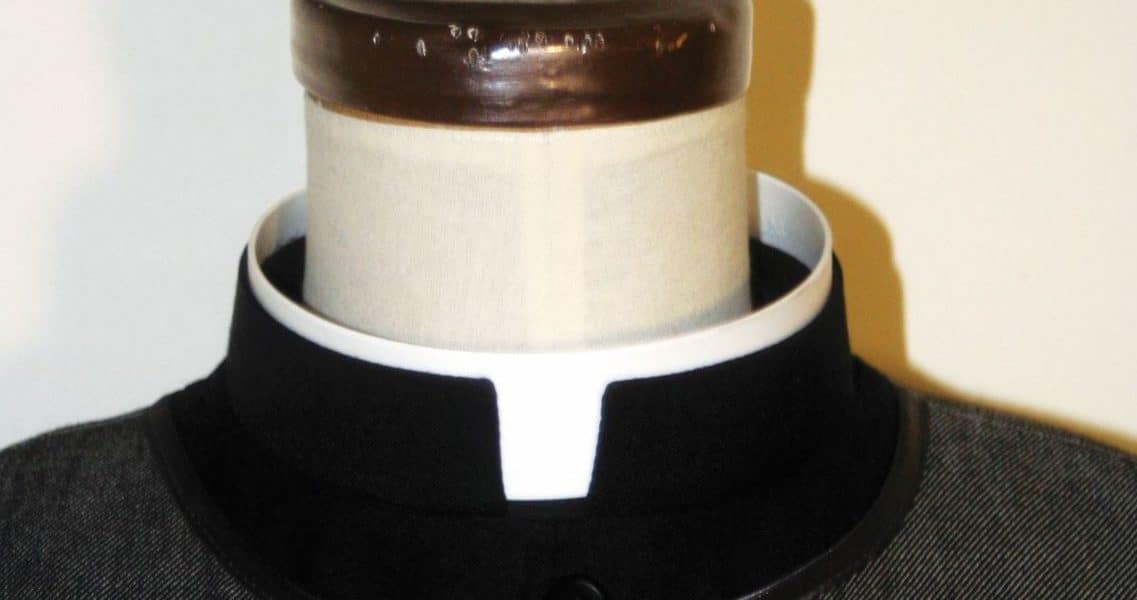
One of the most essential pieces of clergy attire is a dickie. Let me share with women few tips for wearing it in the most flattering way. For example, if you do not have a long neck, a dickie can make your neck look even shorter. When you wear a dickie, avoid round neck tops. Instead, choose v-neck tops in contrasting color, which will visually elongate neck area. Another option that works well for dickies is a turned-up shirt collar. The height of the collar gives rise to a neck. Be sure to button the shirt low to reveal the dickie and further elongate your neck.
Clergy apparel is a phenomenon in the world of fashion, because clergy wear would have to be verified by a standard other than pure beauty. Clergy wear is supposed to be logical and answerable to the will of clergy people and the demanding needs of service.
Clergy apparel plays an important role in communicating the message between pastor and congregation on the visible and invisible levels. Yes, we are taught not to judge by appearance, but remember that, as a preacher, what you wear speaks before you.