


This article originally appeared in the December 2005 issue.
By Larry Lydick
Larry Lydick is director of marketing, sales and engineering for Fiberglass Specialties, www.fsiweb.com.
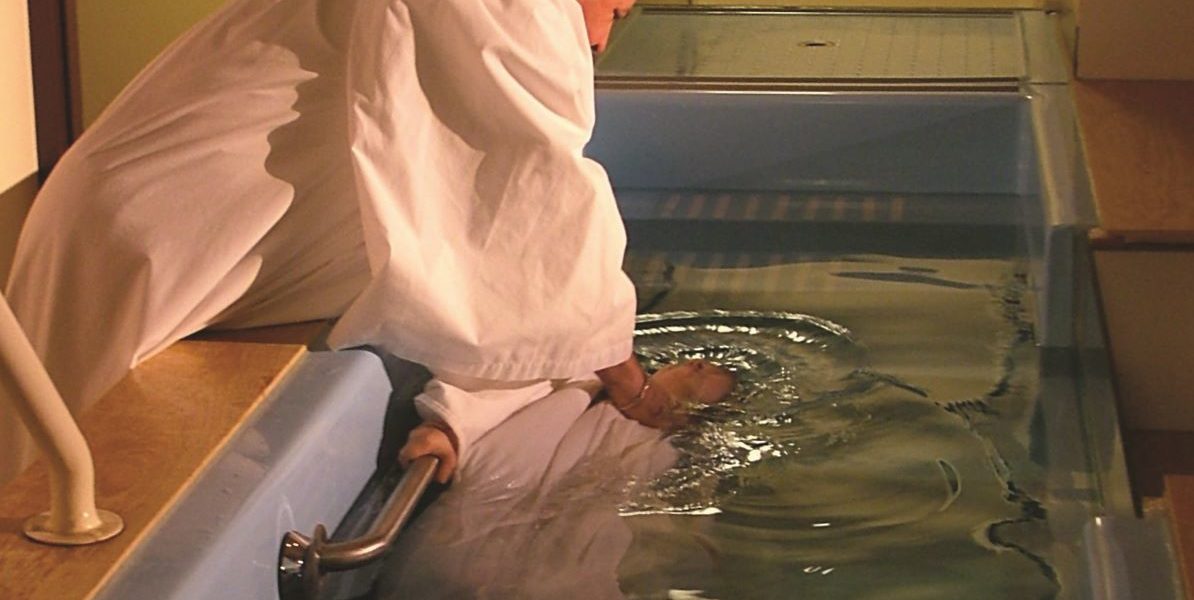
I once read (via Merriam Webster online) that baptism was “admitting the recipient to the Christian community.” It struck me that this definition is emotionally the same as admitting one to a local movie show. Obviously, the person who created the adjectives for this definition has never felt the lifelong warmth that comes from a mutual immersion with Christ.
The event of baptism is life-changing and life-challenging. It is perhaps the most personal, yet public act we will ever perform. Because it is so important, we should applaud any church committee that had to deal with the challenges of installing a baptismal pool in their church.
For future committees, here is a checklist developed from years of dealing with those devoted committee members along with some valuable suggestions drawn from experts in the field. Of course, these are guidelines only, and you’ll want to follow the specific instructions of the pool manufacturer.
Before you begin looking at baptismal pools:
- Determine how much of a footprint can be allowed for the pool within the floor plan of the church. Get as big a pool as possible. The church will grow, needs will change, and a bigger pool allows for more accommodation of change. There is relatively little difference in the initial cost and long-term maintenance between pools.
- Plan on how to accommodate exceptionally large candidates or candidates with physical handicaps.
- Generally determine how electrical and plumbing connections will get to and from the pool.
- How will foot traffic flow around the pool? How will candidates, in wet clothing, get to and from the pool?
- Does the pastor want to be in the pool with the candidate or in a dry area behind the pool? Note: When using a pool where the pastor is in a dry area, the candidate is usually baptized in a seated position.
- Will this be a permanent installation or will the pool be moved in and out of a set area.
- Will there be a viewing window?
Styles
Once the parameters of design have been established, it’s time to review the many styles of baptismal pools available.
Most major manufacturers offer dozens of shapes and sizes, each with a different purpose. It’s important to understand the differences, so don’t hesitate to ask.
Bigger pools offer more comfort, smaller pools have lower operating costs, modular pools offer great design versatility, round pools look elegant – you get the idea.
Having settled on a design or two, here are additional considerations:
- Make sure the design maximizes the usable space in the pool.
- Make sure the steps are large enough to allow for a safe entry and exit. Building codes require an 11-inch step with a 7-inch rise. This is the step size in all public areas, and it’s in our “muscle memory.” Taller steps are more difficult for children, and narrow steps are difficult for elderly people.
- Is this installation going to be inspected by a code authority? Building inspectors have a book of pre-set standards to follow. What they enforce and the degree of enforcement varies by inspector and community standards. If the installation is subject to inspection, be sure to contact the local authority prior to ordering the pool. Plan on presenting a dimensional drawing of the pool and a set of installation instructions – both available from the manufacturer. You don’t need a pool arriving only to find out it doesn’t meet enforceable codes. All plumbing and electrical connections will also be inspected.
Installation
All baptismal pools are pretty easy to install. The pool needs a fairly level surface capable of holding the weight of the pool – generally about 400 pounds per square foot. Set the pool on a sand or mortar base for final leveling. A framework is needed around the lip of the pool to keep it in place and sometimes under the steps. Just follow the manufacturer’s instructions.
Maintenance
Many swimming pool chemicals can destroy the gel coat surface of a baptismal pool. Black plague often follows. If you must use chemicals, only use those approved for use with fiberglass. Some churches leave water in the pool, while others drain.
Draining the pool is the safest and often cheapest choice. A pool full of water is an instant attraction for an unsupervised child. You’ll need a copy of your water bill to figure the cost of refilling the pool. Water is billed in a unit of measurement, generally “hundreds of cubic feet” (CCF). Ask the pool manufacturer how many CCF the pool holds and then multiply it by the cost per CCF to determine the cost of filling the pool. It is generally far less than the electrical costs associated with keeping water in the pool.
Keeping water in the pool presents several challenges. First, the pool still must be drained and allowed to dry as recommended by the pool maker. Water that has been in human contact is no longer sanitary. Do not add harsh pool chemicals to sanitize the water. Use a purification system similar to spas. Ultra Violet or Bromine-based systems work best. Warning: Anything you use or attach to your pool must be approved by the manufacturer to keep from voiding the warranty. Finally, keep children away from the pool.
Heaters
All baptistry makers offer water heating systems. The bells and whistles vary, but they generally are 5,000-watt or 11,000-watt heaters. All heaters should be UL listed and properly wired to a Ground Fault Interrupter Circuit (GFIC) that is regularly tested.
Accessories
Accessories can be the perfect choice for pool upgrades. If the pool does not have a built-in child’s step, then this is a needed item. Other accessories can help make systems more automatic or save money on energy.
Other Pool Types
- Custom Pools – If the shape and design required is not available, then consider a custom pool. It can be made specifically for your church and allows for maximum efficiency of space and utilities. Custom pools are a must for group baptismal. The additional cost is generally minor when compared to total construction costs.
- Insert Pools – Often churches have a poured-in-place or steel tub pool. If getting the old pool out is too invasive, then consider an insert. It is a custom pool designed to set inside an existing pool. Often the existing plumbing electrical and heater systems can still be used.
- Portables – Mostly this discussion has been about permanent installations or pools that can be moved around the facility. There is a whole range of portables that can be used anywhere. Review closely the set-up and take-down of the pool – there are a lot of variables here. Also, make sure the pool is deep enough for complete immersion.
Installers
The best built pool is a problem for everyone if not installed properly. For example, if plumbing lines are stressed, they will amplify the pump noise. A good general contractor will assure a long-term satisfactory product. Licensed spa installers can also be a good choice because the heating and control systems are similar.