





Home About CSP In Every Issue Blog Archives Buyer's Guide Media Guide e-News Subscribe Contact
Check Out The
February 2012 Supplement


Church Architects Choose Glued Laminated Timbers for Their Warmth and Aesthetic Appeal
By: Don Jaenicke

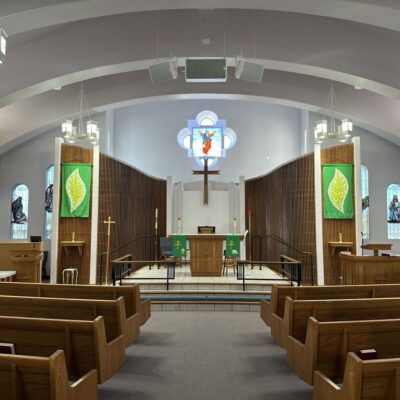
Religious structures are a major market for glued laminated timbers, which often form expressive curves and arches that enhance the spiritual experience.

Architects and designers frequently choose glulams to create interest in their projects by expressing the structure, rather than applying decorations. Glulam timbers are increasingly popular because of their pleasing natural appearance when left exposed.

Glued laminated timber is also a renewable resource, because U.S. foresters plant five million trees each day to ensure a future supply of wood.

Lady Queen of Peace

This church in Madison , Wisconsin , is typical of many churches that have a substantial investment in their present site. They chose to expand the structure rather than moving to a new location that would have been more expensive and created longer travel time for the parishioners.

In this case, the parish was able to increase the seating capacity by 50%, from 1,000 to 1,500, while continuing to hold worship services. The original church was built in a tapered shape of 110 feet at the widest point, narrowing down to 40 feet at the other end. Three existing glulam arches were removed and two new half arches were added on each side. The pews were reversed as the new altar was moved from the narrow end of the church to the wider end.

The new half arches are fastened with moment connections to the original arch rafter. Laminated cedar decking was placed over the two new side wings, with both arches and decking stained to match the original colors.

The complex project was conceived, built and supervised by Flad and Associates Architects, contractors Joe Daniels Construction in Madison and Sentinel Structures of Peshtigo, Wisconsin , the glued laminated timber laminating firm.

John XXIII Catholic Church

A spectacular glulam timber church dome was fabricated on the ground and lifted into place to become an architectural and religious landmark in Albuquerque , New Mexico .

The 60-foot glulam dome is called the "crown" of the John XXIII Catholic Church. It is 38-feet high and weighs 30 tons. Because of precise planning and craftsmanship, it fit into place perfectly on supporting steel trusses with a tolerance of one-half inch.

Twelve arched glued laminated rib members extended on radials from the center of the dome to provide the primary structural support. Circling ring members span rib to rib to support continuous skylights and sub-framing. The stability of the timber under short duration loading meant that no secondary bracing systems were needed to deal with unbalanced snow, wind or seismic loadings. Architect David Callahan said the laminated timber dome provides a warm, attractive interior, is less expensive than steel, and is safer because it was assembled on the ground.

In addition, glulam's inherent fire-resistance permitted the dome to serve as heavy timber construction under the International Building Code, without the beams being wrapped.

Designers were the Sierra Architects, and the contractor was Klinger Constructors in Albuquerque . The laminating firm was Timberweld Manufacturing in Billings , Montana .

St. Geralds Catholic Church

Huge 82-foot glulam timber trusses provide a dramatic interior for the St. Geralds Catholic Church in Omaha , Nebraska . The architects said they chose the glulam system primarily because of aesthetics and economy.

According to designer David Beringer, the open wood trusses allow the interior space height to be maximized, while minimizing the height and cost of exterior walls.

"The added interior volume provides an inspirational character for the space, while enhancing the acoustical quality," Beringer says.

The main glulam trusses support other laminated beams connecting at various angles with special fabricated connections. Top and bottom chords of the two trusses have double 6-3/4" x 30" members to add visual interest.

Lighting systems mounted on the lower chords of each cross truss provide both down-lighting and up-lighting.

The architects are Zeonon Beringer Mabrey Partners. Structural engineer is Nielsen Baumert Engineering, and the contractor is Lund-Ross Construction, all of Omaha , Nebraska .

Don Jaenicke is a technical writer for the glulam timber industry. For more information on laminated timbers, contact the American Institute of Timber Construction, www.aitc-glulam.org.


Voice Broadcasting

©Copyright 2012 Religious Product News
Religious Product News