




Home About CSP In Every Issue Blog Archives Buyer's Guide Media Guide e-News Subscribe Contact
Check Out The
February 2012 Supplement


Selecting Folding Tables and Chairs
By: Gary Heller

I remember taking my first factory tour in 1988. What impressed me the most in that one-million-square-foot factory was the overhead conveyor moving hundreds of folding chairs through the assembly line to the paint spray booth, on to the oven, and then to the packing and shipping department. I stared at the line-up of chairs on their hooks wondering if I would see a hook without a chair hanging on it. I didn't. And that day, this one factory produced more than 1,250 folding chairs. And the next day they did it again, and so on.

In a different section of this same factory, workers were slicing into 4-foot by 8-foot sheets of 3/4-inch-thick particle board to form the tops that would later become folding tables. There were huge piles of tops being squeezed by giant presses, in order to help secure the durable laminate that would become the decorative surface of the folding table. Elsewhere, steel components were being formed on machines that look like they could have built the first Model T car. I'm not sure how many folding tables they produced that day, but I did know that those tables would be gone from the dealer's shelf in mere hours.

Folding chairs and tables continue to be popular for organizations around the globe. And for churches in particular, they are a staple. If you joined your church when it was just a few families, folding furniture was important to you, since it was all that your congregation could afford at the time. As your church grew, so did the need for more chairs and tables, and so you purchased more.

Today, it is not unusual for a church of average size to have hundreds of folding chairs in daily use or compactly stored in closets to be pulled out at a moment's notice. Read on to learn what you need to know before make your next folding furniture purchase.

Folding Chairs

Twenty or so years ago, the task of selecting the right folding chair or table was easy. There were just a few choices in the market, and any of them would have done a reasonably good job. Today, with the myriad of activities that take place at a church, it would not be unusual to find several different types of folding furniture products in use at the same time.

Folding chair construction today focuses on extra reinforcements. For a folding chair to be considered heavy-duty commercial grade, it must have at least two leg braces connecting the legs on the left side with those on the right. The leg braces can be welded in place or riveted. Either method works well. In fact, you will find many chairs today with triple leg braces (one in the front and two in the back), thus eliminating the chance that the chair will wobble from side to side.

In addition, some chair models include double hinges where the top of the front leg meets the top of the rear leg. This pivot point on most folding chairs takes a beating, and so the logic goes that the more hinges on each leg the better. However, you still need to balance these enhanced construction features with the reality of your budget.

Another consideration in selecting the right folding chair is to decide if padded upholstery is desired. Pads on folding chairs do more than make the sitter comfortable for longer periods of time; they also enhance the beauty and uniqueness of your church environment. Most folding chair pads are available in easy-to-clean vinyl or soft breathable fabric. Look for fabrics made with nylon since they are typically more durable.

Polyester and olefin fibers are also popular and will give you good serviceability. Because you don't want to be buying new chairs often, ask to see the results of testing done on the fabric by the mill. The best kind of test of a fabric's durability involves testing the number of rubs against it that the fabric can endure before it abrades through. The test results are expressed as "double-rubs," simulating a person sitting down and then getting up. The higher the number of double-rubs that a fabric can sustain, the longer the life span it will have.

Some folding chairs combine steel frames with polypropylene seats and backs. Using these soft plastics enables factories to create more interesting shapes and cut-out designs that are difficult and expensive to do on all-steel chairs. It also increases the number of colors that can be produced, thus giving you more choice. Is polypropylene durable enough? Yes, in most cases. Poly is the most popular material used on school chairs today. Expect a life span of 12 to 15 years if well constructed and used every day.

There are other aspects involved in purchasing folding chairs that you will want to research before making your final selection.

1. Are there any local or state codes that require flammability certifications?

2. Is it the wish of the donors, the congregation or the board of directors to purchase products made only in the United States ?

3. What guarantees are available from the dealer or factory, and how long do they last?

4. Will the dealer or factory make available replacement parts such as chair tips or replaceable cushions once they wear out?

5. How do you intend to transport and store the chairs when they are not in use?

Folding Tables

As to folding tables, prepare yourself for a world of choices. Just a decade ago, the variety of folding table models almost always revolved around a wood core top and steel frame.

Today, your decision on which table works best will certainly involve an exploration into new materials and constructions features, as they vary widely. But first, you must consider how you intend to use these tables. Understanding how the table will be used will not only translate into greater satisfaction, but product longevity and, ultimately, cost savings as well.

Certain aspects of construction are generally true for all folding tables. All tables will have some type of leg tip or glide, generally made from rubber or hard plastic, and occasionally from chromed steel. The legs must have a locking mechanism that can be as simple as a metal collar that drops into place by gravity and prevents the legs from folding under when in use. Better tables have spring-loaded leg locks that not only keep the legs locked in the open position, but also help keep the legs closed while being transported.

Next, look at the edging on the table top. Unless the top is a one-piece plastic affair, you will want to see either a rubber bull-nose or metal trim. This trim protects the table edge to prevent laminate damage and chipping. For tables with a metal edge banding, the best is made with a galvanized steel material versus aluminum. If you are rolling your table into and out of storage on its edge, the aluminum banding will deform and create sharp edges that will cut your hands. Steel banding will not deform and so is safer to handle.

Finally, almost all folding tables will have some sort of metal apron running underneath the table top. The apron's chief purpose is to add stability to the top, especially helpful for the larger sizes up to 36 inches by 96 inches. On the more expensive tables, the apron is not seen externally under the table top, but is incorporated within the top shell itself.

Types of Folding Tables

The most economical folding tables made today either employ a particle board wood top or one that is made of blow-molded plastic. Particle board tops in the low price range are usually 5/8-inch thick and are covered by a vinyl melamine surface that is secured using adhesive and heat. While this table will prove very serviceable in most locales, it is not appropriate for food service.

In recent years, blow-molded plastic tables have become available for about the same price as melamine. They too are light-duty tables, but just as appropriate for the office as in the cafeteria. Their shortcomings are that they can't support a lot of weight on their tops, and they will not last long if the tables are unfolded and folded on a frequent basis. Nevertheless, they have become an overnight sensation, not just because of their relatively low price but also because their lighter weight makes for easier handling.

Next up the ladder are the Novoply core high-pressure laminate tables that have 3/4-inch tops. Most have moisture-blocking backer sheets and top coverings in a wealth of styles and colors. Their tops can withstand tough daily use, including scorching hot coffee pots placed directly on the surface. Their thicker tops almost give the screws that hold the frames and legs together more gripping power. What is least attractive about this level of table is its weight. To move these tables, you would need either two people to handle them or employ table trucks.

Plywood core tables are next. These are the tables that meet the demanding needs of hotels and catering halls. They can withstand rough handling and daily setup and breakdown. You can order these tables with a simple sealer stained top or covered in a high-pressure laminate. If you opt for the simple plywood top, you will want to invest in either throw covers or toppers with skirting to hide the somewhat unfinished look. It would be a shame to cover a laminate surfaced table top, but consider using table skirts to dress it up.

Once past the top-of-the-line wood core tables, you move into high-grade tables, usually made with ABS plastic cover tops. These tables can support extraordinary amounts of weight. Their inner cores include durable materials such as lumber core or extruded aluminum. You may also find that their frames include thicker steel walls and larger diameter legs. Using modern materials, these tables are also lighter in weight than any wood folding table, but somewhat heavier than the inexpensive blow-molded tables. These ABS tables are at the top of the cost scale, and they will generally last longer than any other kind of folding table under similar conditions. Still, they are limited in color choice, and, like all the tables previously presented, they are for use indoors only.

Finally, the table that provides the ultimate in strength, durability and light weight is made of aircraft aluminum. Yes, it is at the top of the price scale, but the 30-inch by 72-inch table can hold weight exceeding 1,500 pounds. You can leave the table outdoors since aluminum will not rust. And, there are many epoxy powder coat colors available. This folding table is truly in a class by itself.

Now that you're thinking of the decisions you will need to make, and the needs you will have to consider, put some product catalogs on a folding table, seat yourself in a folding chair, and begin your shopping!

Gary Heller is general manager of Alfax Furniture, www.alfaxfurniture.com . If you have further questions, contact Gary Heller at 800-221-5710, ext 546.

Sidebar

Product Roundup

Toddler Tables
The Toddler Table brand is ideal for feeding, teaching and other activities. They work great in daycare centers, Sunday schools and anywhere that childcare is provided. Since the design of the original Toddler Table, they have added a number of models and colors. Table tops are made from 1-1/8-inch laminate, and table edges are covered with high-impact molding. Tubular steel legs provide strength and stability that can withstand constant use and unexpected weight demands. Toddler Tables' high-impact plastic seats are made to last, while providing ease of cleaning and maximum comfort for children up to 30 pounds. Toddler Tables come in a variety of sizes to meet all of your childcare needs. Table height is available in 14 or 27 inches. The tables are also equipped with bent tubular legs that are designed for extra strength and support. Most table models feature removable plastic seats that are easy to clean. And for added safety, each seat is equipped with a seat belt.
www.toddlertables.com

Embrace from Church Chair
The new Embrace (patent pending) chair by Church Chair Industries is "the chair that hugs your back." As an innovator in sanctuary seating for more than 20 years, Church Chair continues to respond to the quest for seating comfort with this handsome chair. The ergonomic specifications of the Embrace provide sustained seating ease, giving the sensation of being enveloped or "hugged" in support. With 4-1/2-inch premium foam padding in the rounded seat cushion and lumbar support included as a standard feature, this impressive chair is an excellent addition to any facility. Its innovative comfort contours, along with its sophisticated design style, assure the Embrace long-term popularity in the sanctuary seating industry.
www.churchchair.com

Southern Aluminum's Lil' PikNik
The Lil' PikNik table by Southern Aluminum is specifically designed for churches, school, camps, daycares and other facilities requiring a safe and durable product for children. A small version of the popular Southern PikNik table, the Lil' PikNik is engineered to be wear-resistant. The Lil' PikNik is durable enough to be used both indoors and outdoors. The lightweight aircraft-grade aluminum Lil' PikNik table can support more than 900 pounds of weight. The table top and seats have generous radius corners to prevent injury, and the benches have a no-tip design. The Lil' PikNik is available in four bright powder-coated finishes and comes with a 99-year warranty.
www.southernaluminum.com

Alfax
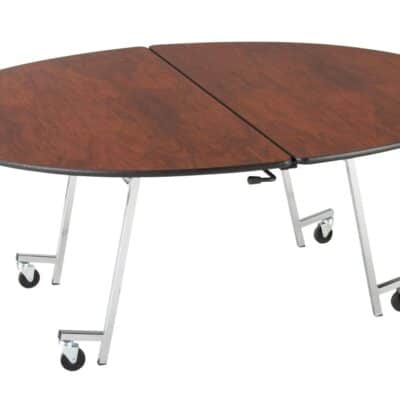
With so many different kinds of folding tables on the market today, it's a challenge for churches to find the right ones. Alfax Furniture makes the shopping experience easier by offering wide range of folding table options. Alfax staff guide customers through the choices to find the one that works best. The folding table shown here demonstrates Alfax's trademarked Super-T bracing for superior frame strength. Coupled with a ¾-inch-thick Novoply top and solid-color high-pressure laminate, this table will work just as well in the cafeteria as it does in the classroom.
www.AlfaxFurniture.com/products

Commercialite by McCourt Manufacturing
At roughly half the cost of traditional plastic folding tables, the Commercialite is one of the strongest, lightest, most affordable indoor/outdoor folding tables on the market. Blow Mold technology allows McCourt to produce polyethylene plastic tops to resist heat, stains, chemicals and physical damage. The U.S. Steel frame with wishbone folding leg system bolts through the table top, not just into it, allowing the Commercialite to support more than 3500 pounds. A wide variety of sizes and options are available. Hundreds are sold daily to churches, schools, rental companies, conference centers, hotels, parks and private businesses.
www.mccourtmfg.com

Mity-Lite
In the market for lightweight, durable folding tables? Mity-Lite's incredibly strong ABS plastic tables hold more than 1600 pounds, but weigh only 42 pounds. That means no more injured workers or heavy tables that get dropped and damaged. And, since Mity-Lite tables are built to last, churches save time and money in replacement and repair. Customers can choose from more than 50 different sizes, in a variety of colors and leg options.
www.mitylite.com

Lightweight Blow Molded Folding Tables by Tablesnchairs.com
These sturdy Lightweight Blow Molded Plastic Folding Tables are the perfect solution for the banquet hall or cafeteria. Use them indoors or outdoors or anywhere that calls for an affordable, lightweight, weather-resistant and highly durable folding table. Round tables hold a maximum of 2,000 evenly distributed pounds, while rectangular tables will hold a maximum of 1,500 pounds. All tables are 29 inches off the floor, with a tabletop thickness of 1.75 to 2 inches. All legs are made of 1 1/8-inch, round 18-gauge steel. Tables come with a five-year NPS warranty.
www.tablesnchairs.com


Voice Broadcasting

©Copyright 2012 Religious Product News
Religious Product News