



Home About CSP In Every Issue Blog Archives Buyer's Guide Media Guide e-News Subscribe Contact
Check Out The
February 2012 Supplement


Grace Baptist Church
By: Bernie Satrom

Twenty years ago, the 17 acres of gentle rolling hills in the country were a great place to dream and begin building a church. Grace Baptist Church in St. Charles, Missouri, had been meeting in a rented CB shop and then a small church. Now they had a place to call home. First came a couple of modular buildings that were used for church services and Sunday school. Then came a series of buildings lined up in a row, reminiscent of the Quonset barracks in the Gomer Pyle TV show. Next came a metal building and gym, and later, more length was added to both.      
  
Fifteen years later, the 17 country acres were now near a major exit on the interstate with many restaurants, strip malls and shopping malls added to the area with the promise of hundreds of new homes surrounding the church. The metal building, which had initially served well, was short of space. The pastor and church leaders had promised a new sanctuary, and the time had come to make that happen and turn the old building into needed educational space. 
   
The first step was to choose an architect. After interviewing several local architects, the church chose Maranatha Custom Churches. Aside from saving on the design, the church liked having someone who specialized in the design and construction of energy-efficient worship facilities for churches. 
  
The first step in the design process included a brainstorming session. Several members of the building committee, including the pastor, came to Maranatha’s headquarters. Among the members was an Awana leader, a project manager with a mechanical engineering firm, a construction manager who built large public projects, and the choir director who ran a computer consulting firm. During the two-day retreat, the team worked with architects through a needs and vision examination and drew the plans to meet those specifications.
 
The church outlined several needs and desires that interfaced nicely with Maranatha’s philosophy. Leaders were looking for energy efficiency, ability for easy expansion, intimate seating arrangement and high-quality materials. At the same time, they wanted to be very careful to be good stewards of God’s resources. 
  
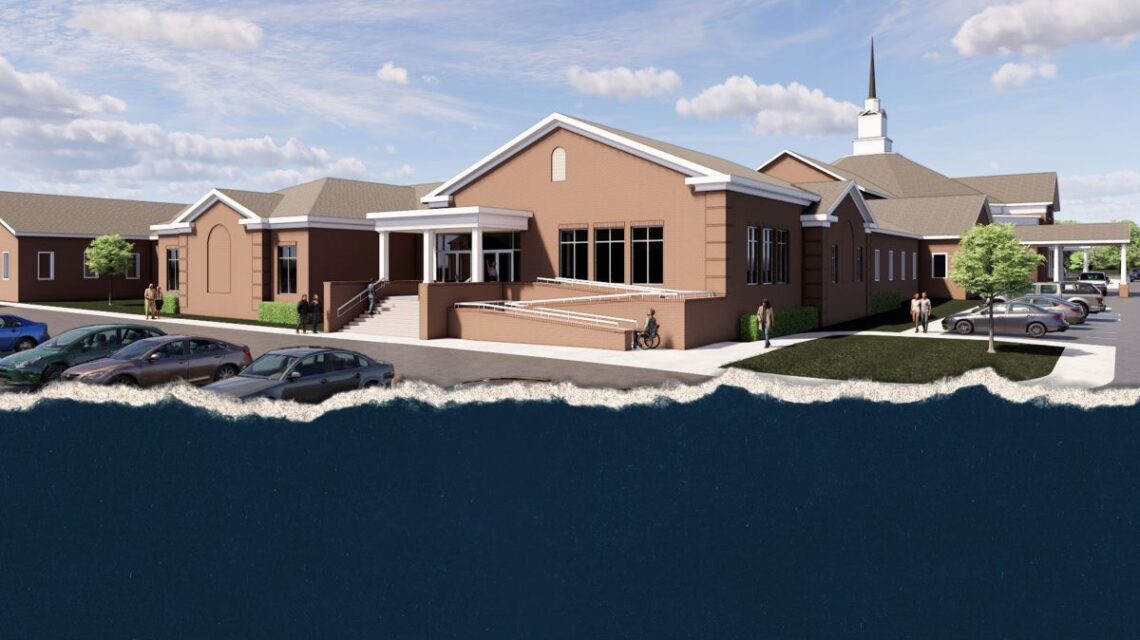
As it is, the building design consists of a 120-foot-diameter octagon with a partial wrap around the front and a large porte cochere with initial seating for 750, easily expandable for up to 1,600 with an undeveloped balcony. Expansion of seating into the foyer is also an option.   
  
The large, clear span structure has no load bearing walls, so walls can be added or deleted at any time. Even the exterior walls were designed to be non-load bearing so that seating

expansion could extend beyond the initial eight walls. Structural insulated panels, similar to those used on “This Old House” and “Home Again,” were incorporated into the building. The Styrofoam-cored walls are twice as strong as conventional stick construction and about 40 percent more energy efficient. As an added bonus, they come numbered with openings for doors and windows that help them to be constructed more quickly.
   
The mechanical system virtually eliminated ductwork by using a unique Air Floor system. With a floor cavity as the ductwork, the system is considerably quieter than conventional duct systems, and, as an added benefit, there is a radiant floor. Now, holes can be cut in the slab almost anywhere to add ventilation, if the floorplan changes. This could save large churches thousands of dollars in mechanical remodeling in the future. 
  
The Maranatha Sunburst ceiling provides a high level of indirect lighting that accentuates the beautiful, coffered ceiling while providing acoustical benefits as well. The Norwegian-designed H window was also part of Maranatha’s design and construction package. While most windows have a 20+ year life, the H Window is a quality alternative that is essentially permanent. They are typically three to seven times as tight as many windows utilized in churches and also offer triple glazing with Double Low E, which provides an R Value of around 5. These windows can save $2 to $3 per square foot per year compared with comparable windows in some environments, plus churches don’t have to replace them in 20 years.
  
 In addition to the architectural shingle and brick, the design called for the use of some EIFS. Strukturoc, a steel panel that is coated with a synthetic stucco finish, was used instead. Strukturoc is pre-finished in a variety of colors and provides a high-quality option at a reasonable price. 
    
One of the other reasons Maranatha recommended it was because of its ability to demount, meaning it can be removed and reused in the future. The Strukturoc was used on walls where future expansion will occur. The plan was to create a no-maintenance exterior without sacrificing beauty.
   
As part of the design package, Maranatha also provided the design and installation of the audio system. By utilizing an acoustical design program, Maranatha was able to predict the acoustics and provide the very best audio solution. This was done early in the design phase. Included in the equipment was a real-time adaptive equalizer, which automatically adjusts the EQ. Regardless of the humidity or the number of people in attendance, the acoustics will always produce a quality sound throughout. 

In addition to sound in the foyer, nursery and all other rooms, an excellent sound system was incorporated into the car port. This gives the church the opportunity to pipe great music out to that space and start creating an impression and setting the mood as people walk into the building. 

Bernie Satrom is the founder and president of Maranatha Custom Churches, Inc., www.Buildingbyfaith.com. The company specializes in high-quality, expandable, energy-efficient buildings at a reasonable cost. Maranatha provides full architectural, engineering and construction services in all 50 states. Satrom enjoys finding creative, God-honoring solutions for church growth needs. 

In a Nutshell

Church: Grace Baptist Church
Location: St. Charles, Missouri
Membership: More than 1,000, with a weekly attendance of approximately 450
Project: Design and construct a new facility for this church, which had outgrown its former building
Size: 16,200 square feet, with an added balcony area of 3,854 square feet and a carport area of  3,282 square feet
Cost: $4.5 million
Challenge: The church wanted to build for future growth, while staying within today’s budget.
Solution: The sanctuary, which now seats 750, can be expanded to seat 1,600 or more through completion of the balcony area and adding seating in the foyer. The structure was designed without load-bearing walls, so adding new construction will be simpler and less expensive in the future. 


Voice Broadcasting

©Copyright 2012 Religious Product News
Religious Product News