



Home About CSP In Every Issue Blog Archives Buyer's Guide Media Guide e-News Subscribe Contact
Check Out The
February 2012 Supplement


Church Signs Selecting Seeker-Friendly Sign Solutions
By: Randy Metcalf

In this era of “seeker-friendly” sanctuaries, it is ironic that proper signage programs are all too often neglected in church facilities. There is hardly a more uncomfortable feeling for a visitor in new surroundings than the feeling of being lost. There is a certain level of heightened anxiety for new visitors just to enter the front doors. This anxiety only escalates once they discover that they do not know where to go once they are inside.

Although church regulars may be an extremely friendly and helpful group, eager to assist a visitor in finding the nursery or a youth room, the visitor usually prefers to find their own way and pass through unnoticed until they become more familiar with the church. An effective sign program can help put them at ease and allow them to settle into their new church home at their own pace.

The focus of this article is actually to serve as a synopsis of sign materials, but a little background in sign system planning will help make those selections more meaningful.

An effective sign program for a church facility should involve a hierarchy of signs that a visitor may encounter and a defined role for each of those sign types. Church facility planners should try to consider how all of these factors would work together as a cohesive collection of informative devices rather than treating them on a case-by-case method.

The traffic pattern may be seen like the circulation system in a human body. The front door or parking area may be the heart pumping people to arteries through which individuals are directed to smaller veins of traffic until they ultimately arrive at capillaries on the room level.

Outside the Box
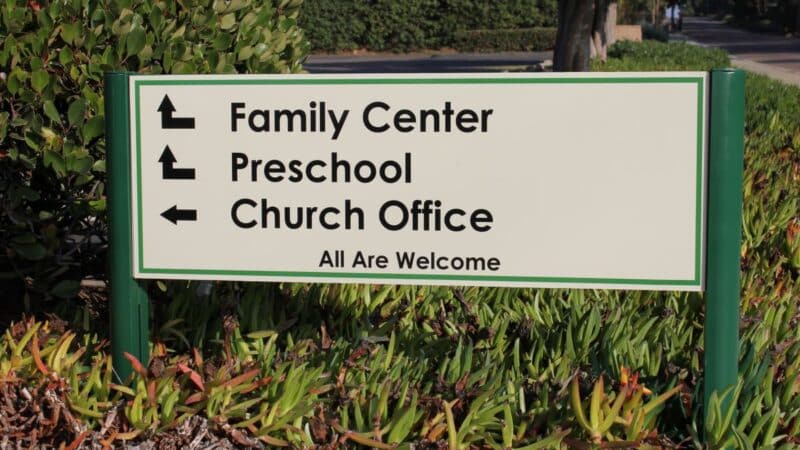
The hierarchy should consider the typical path that may be taken by a visitor, and funnel masses of people down to specific room destinations. Materials, colors and fonts are typically used to maintain cohesion from one sign to the next. The initial interaction with the visitor should be broadly inviting, while the next level should interpret decision-making points and provide general direction to multiple destinations. Smaller, more specific wayfinding directionals may follow, but maintain the color scheme and other style features. Activities within individual rooms of a growing church are always changing, so choose room identity signs that allow for flexibility.

The hierarchy of signs begins with the exterior of the building and parking lot signs. This is often the only image a new visitor has of a church, so it should be an inviting image. It is a sad truth that the roadside entry sign and the building itself serve as an icon of the church. Left neglected, this may be a poor representation of the real, vibrant church body that is inside the church walls. If church planners have the opportunity to start with a new sign project here, materials and colors should be compatible with other materials used on the building itself.

A few common and effective sign types used here are pedestal monuments, freestanding pole structures, and stud-mounted lettering. Pedestal monuments may incorporate a sign cabinet that may or may not be internally lit, an applied signface, such as a sandblasted sign, or stud-mounted letters. A pole structure typically involves a monopole, or a pair of metal poles, with a sign cabinet mounted 8 feet or higher above grade. Another common sign application is stud-mounted dimensional letters attached to the surface of the building. This type of signage may have a halo glow backlighting effect if desired.

All of these examples are traditional forms of entry signage. The advantage is that they are all field-tested, and the benefits and drawbacks of each can be easily discussed. The bad thing about this is that they are “traditional,” and this is the very thing many churches are trying to avoid today. Worship styles and cell group interactions may provide a great change from stereotypical church life, but many churches allow their approach to signage to remain status quo. Discuss some alternative sign options with a representative of a sign company or an architect if you would like some ideas to customize the standard sign approach.

The freestanding pedestal monument can most easily incorporate architectural features of the church building. The base and background can be composed of brick, metal, cast concrete, cultured stone, textured plaster or any combination of all. The pedestal monument may involve an internally lit cabinet or feature ground mounted spotlighting on a surface mounted sign substrate. The internally lit cabinet is an aluminum framework with a sign face that includes a translucent acrylic signface that allows light to emit through the signface for nighttime viewing. This may be a solid sheet of acrylic with applied vinyl graphics or reverse-side painted graphics. This style of sign cabinet is popular due to its ease in fabrication and maintenance. These are typically internally lit with fluorescent lights.

Another form of sign cabinet growing in popularity includes “push thru” lettering. The signface of a push thru style cabinet involves an opaque material, such as aluminum, with routed spaces removed to allow a thicker piece of acrylic to push through the void in the routed spaces. This acrylic lettering may be pieces of acrylic with non-graphic areas milled down to a lower plane, or it may be vacuum-formed letters. These letters are mounted on the internal side of the opaque routed material with the taller portions of the letters passing through the void created in the routed opaque piece. People are beginning to find these very appealing because the varying levels of depth provide a more interesting use of dimensional character. They are also a more subtle way to provide lighting for the sign without lighting the entire face of the sign. They, too, are usually lit with internal fluorescent lighting. It should be noted that this style of sign is often heavier than the traditional sign cabinet due to the additional materials involved.

The sign cabinets previously described may be used on the pedestal monuments or freestanding pole structures, or even mounted to the side of a building if desired.

The pole structure base may be advantageous if your location requires an elevated sign height for preferable traffic visibility. This may also be a good choice if the sign location has a limited amount of footprint space on the ground. On the flip side, the pedestal style of base is resistant to the effects of aging because it is not composed of painted areas that may fade, or metals that may rust.

A note about lighting: It is relatively easy to replace the internal fluorescent bulbs, and it is even easier to change external spotlights. Fluorescent lights generally last longer than the external spotlights. Fluorescent lights also usually include a ballast that may require replacement over the life of the sign. This should be done by a sign professional or a certified electrician.

One final style of external signage is stud-mounted letters. This consists of individual three-dimensional letters that are mounted to a surface. These may be applied directly to the side of a building or attached to a cabinet or monument. These are available at a fairly cost-effective rate by manufacturers, but they are relatively limited in font and color selections. They can be custom made by many sign shops by routing out of materials such as acrylic, high-density urethane, or aluminum. Of course, spotlighting can externally illuminate them if so desired. They can also be halo-lit by mounting bent neon or LED light strips on the backside of properly prepared letters that are mounted with an adequate standoff distance from the mounting structure. A sign professional should perform maintenance of this type of lighting.

Interior Signage Selection
Upon entering the church, you have the opportunity to reinforce a positive representation of the worship center or dispel a poor image. Sign material selection and styles are a part of that solution. The length of this article does not permit a lengthy discussion of the importance of legibility, color combinations or sizes. I’ll assume the sign maker selected will be educated in this area to help sort these matters out. Nor does this particular article address the issue of ADA compliance of certain signs. There are just too many variables for those topics. This article simply points out some of the characteristics of popular sign materials in an effort to provide some form of an educated selection process when it is time for church planners to choose sign materials.

The most popular material is plastic, but within the description of plastic, there is an array of choices. Plastic was once viewed as a weak choice to wooden or metal products, and it carried a stigma of inferiority in the eyes of the consumer. Plastic substrate producers have now developed products that offer a greater versatility in design choices. Solid color selections, laminated metallic surfaces and faux marble finishes are just a few options that are now readily available. All of these may be modified with paints and used in combinations to provide some very creative designs. Most of these plastic choices are adequately resistant to damage if struck by something. These plastic substrates are also lightweight should one somehow fall from its mounted location. Some popular materials include expanded PVC, laminated styrene sheet goods, and Corian style countertop materials. The most popular method of lettering these substrates is computer-cut, adhesive-backed vinyl letters. This is usually the most cost-effective solution, and it can be changed in the future with only minor effort.

Some extra dimension can be added by sandblasting the material, routing a graphic into the material, or applying routed elements to the surface of the substrate.

Another form of dimensional plastic substrates is phenolic, or photopolymer signs. This type of sign is formed through the use of emulsion chemicals and exposure to light that leaves masked areas raised and unmasked areas “dissolve” to another level of depth. Keep in mind that any “applied” element can also become a “removed” element if it is not secured well to the substrate.

Another popular plastic sign substrate is high-density urethane. It is lightweight, and it is available in thickness up to 2 inches if a more a more substantial sign is desired for aesthetic purposes. It is very versatile for use with creative dimensional signage in that it can be sandblasted, carved, or routed and layered. It is softer than other plastic materials, so it should be coated with a hardening sealant if it is used in high-traffic areas that may be susceptible to physical contact with the sign.

Varnished woods and lightweight metals are certainly good options when matching the signs to existing architectural features. Cut vinyl lettering can be applied to these surfaces as well. It should be noted that the surface should be as clean and smooth as possible for optimal adhesion of the vinyl letters. Porous or textured surfaces reduce the effectiveness of the adhesive letters.

Many manufacturers offer interchangeable sign solutions for assigning rooms. This usually consists of a standard frame with blank slide-in components that are typically lettered with the aforementioned vinyl letters. Some allow for paper templates to be printed on a laser or ink-jet printer. Many are limited in styles and colors in order to allow for broad, universal applications. Unfortunately, this often appears to be very institutional and lacking unique character. These may be dressed up by applying them to another, more visually appealing substrate that is more flattering to the rest of the building’s interior design. Some manufacturers are now producing more aesthetic choices for these, so it may be worth your efforts to seek those out if the standard styles are not satisfactory.

Sum of All the Parts
Sign systems for religious centers are often overlooked. This often occurs simply because there are so many variables and choices that church planners may not know where to begin. Signs merge aesthetics and functional messages, and sometimes these are difficult to align. Sign selections are often determined based on something seen at another location. Be careful not to fall into that trap. Share what you wish you could have with your sign provider, and allow them to help you determine how this can be optimized. You will most likely find that the result is better suited for your needs than what was seen at that other location.

Church facility planning is currently more exciting than ever. Opportunities to explore new ideas are more welcomed than ever. Be sure to plan a welcoming sign program for your church visitors. Thanks to technological advances and improved manufacturing processes, cost-effective material options are more available than ever before. Take some time to seek out some more “seeker-friendly” sign solutions.

Randy Metcalf is a graphic designer who has been working in the exhibit design and sign industries for 15 years. He is currently employed by SharpSigns, www.sharpsigns.com.

Product Roundup

Stewart Church Signs
Since 1968, Stewart Church Signs has provided many churches with top-quality signage. Stewart signs feature:

  • Graffiti-resistant finishes
  • Vandal covers
  • Lifetime warranty

Stewart’s sign consultants work with churches to create signage that fits the particular church.  The result is a communication tool that invites guests, informs the community and inspires passersby. 
www.stewartsigns.com

Signs for Faith
Signs for Faith has 40 years of experience designing and building signs that attract new members to a congregation now and for years to come. Churches need the right sign to capture the attention of the public and encourage them to stop in for a visit. Signs for Faith signs feature:

  • Sturdy construction to last many years
  • Beautiful design
  • Personalization unique to a church’s image

Signs for Faith has mastered the production of signs for churches across the country.
www.SignsForFaith.com

MPC Signs
MPC Signs, with more than 57 years of experience, is a leading manufacturer of internally illuminated message board signs, way-finding signs and electronic message centers. MPC Signs feature:
  • All-aluminum construction, using state-of-the-art tooling to build signs to exacting standards
  • UL listing, ensuring the highest quality of materials and workmanship
  • Easy installation

A “Create Your Own Sign” CD walks churches through the process of designing a sign.  www.mpcchurchsigns.com

Innovative Church Products
Innovative Church Products spent many years interviewing hundreds of church leaders about their signage needs.  By uncovering deficiencies in traditional church signs, the company used new technology to design and develop a new generation of products.  ICP builds innovative signs that are:

  • Attractive
  • Long-lasting
  • Easy to change
  • Easy to service
  • Vandal-resistant

New technology reduces the long term investment of owning a new sign.
www.icpfl.com 

HTS Changeable Banner System
Hundreds of churches around the world are using the Sign Shop Changeable Banner System by HTS. The system uses Velcro to adhere plastic letters, numbers and symbols to the face of the banner. This allows churches to:

  • Change the banner's message
  • Promote the church in different ways
  • Highlight upcoming events
  • Make announcements

The versatility of this system saves time and money.  For a limited time, the company is offering churches a 10 percent discount and free logo.
www.htssignshop.com

INNERFACE
Since 1971, INNERFACE has been a "client-focused" industry leader providing complete solutions for:

  • Interior/Exterior Signage
  • Touchscreen Systems
  • Wayfinding
  • Environmental Graphic Design
  • Budgeting, Installation and Maintenance

They provide a 100 percent guarantee on all products and services.
www.innerfacesign.com

AdsLED
AdsLED starts by educating you about LED Message Displays. They listen to your needs and then offer the best solution that is effective for your location and easy on your budget. Their LED Sign Systems come ready to install with everything you need, including:

  • Custom artwork on your sign cabinet
  • Pre-loaded messages on your LED Message Display
  • Engineered pole with anchor bolts and footer drawings.

Plus, their Content Management Program (CoMP) provides free message templates
and animations to keep your LED Message Display fresh and effective. 
www.adsLED.com

SIGN*A*RAMA Messenger Sign
The downfall to changeable copy signs has always been that they are a prankster’s dream, susceptible to embarrassing rearrangement and theft of letters. The new patented Messenger sign from SIGN*A*RAMA is designed so that pranksters cannot tamper with it.
* The two-part system has a removable letter cartridge and a fixed sign track.
* Simply insert each individual letter into the removable letter cartridge to form your message.
* Then, slide the cartridge into the sign track and lock it up.
This lightweight, all-aluminum system allows the user to bring the letter cartridge indoors, encouraging frequent and effective message changes even in adverse weather conditions.
www.signarama.com


Voice Broadcasting

©Copyright 2012 Religious Product News
Religious Product News