



Living Word Family Church, Naples, Florida
By: Frances Putman
Living Word Family Church is a fast-growing congregation made up largely of young couples and families in Naples, Florida, a Gulf Coast community. When church leaders realized it was time to expand, they worked with representatives from Sparks--an architecture, engineering and interiors firm--and Daniels & Daniels Construction, with the two firms using a team approach to create a master plan, build a new facility and set the course for future growth.
Naples is located near the Everglades, and much of the available property was in areas designated as protected wetlands by the state of Florida. In fact, the property the church selected—a 300-foot by 1300-foot, 20-acre parcel, included about 16 acres of protected land. But the church was aware of the designation and was willing to work around the challenge.
According to architect Viviana C. Varnado, the property is considered wetlands, though it has been dry for 30 years or more.
"The state is very protective of the environment, which is a good thing," said Varnado, AIA, NCARB and director of Sparks' Spiritual division. "They want to discourage people from building on wetlands and encourage them to leave part of the area natural or face penalties."
Because of the designation, the church was required to pay a fee of $40,000 per acre for each acre that was to be developed. That added more than $300,000 to the cost of construction.
"In order to mitigate these costs, we explored ways to design in a cost-effective way," noted Varnado, "For example, taking advantage of Florida's benign climate and creating exterior circulation in the buildings with covered balconies and walkways. Building spaces that do not require being heated or ventilated resulted in significant savings to the church."
To limit using the wetland areas, the church is being constructed on the far end of the property, spilling over as little as possible onto the protected acres. But, that has left a significant amount of undeveloped land in the front of the property, facing the street.
"You drive approximately 500 feet into the property through a thick forest before you see the church," Varnado explained. "The solution proposed to achieve a presence on the main street that indicated the location of the church was to create a sign component with a three-dimensional character that had similar components as the church building. This creates an identity that gives recognition at a distance before even reading the name of the church on the sign."
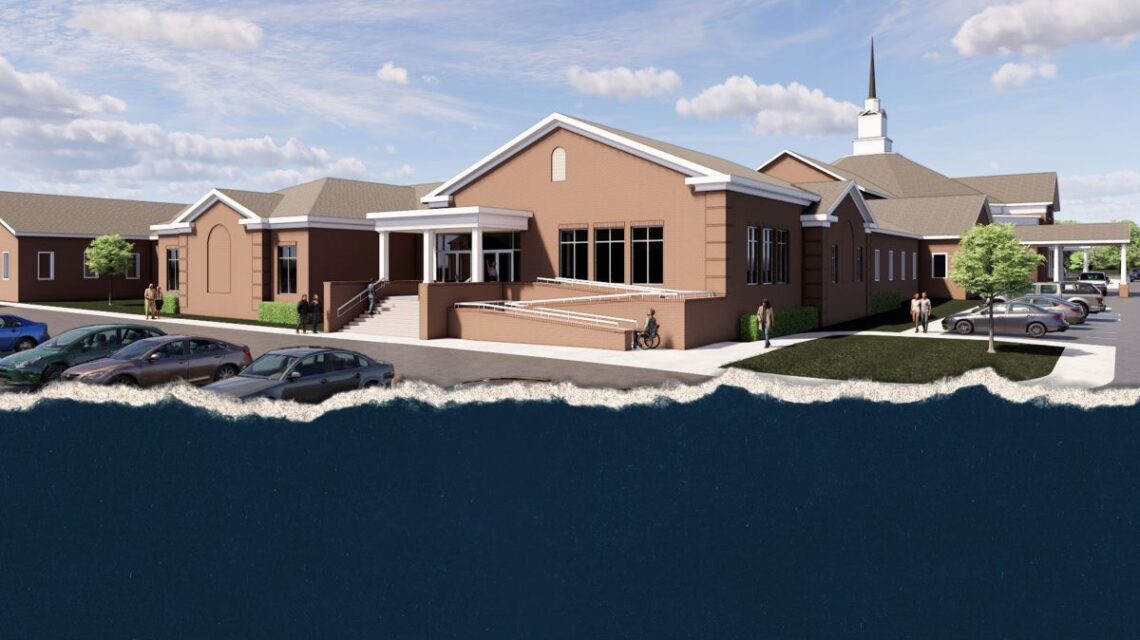
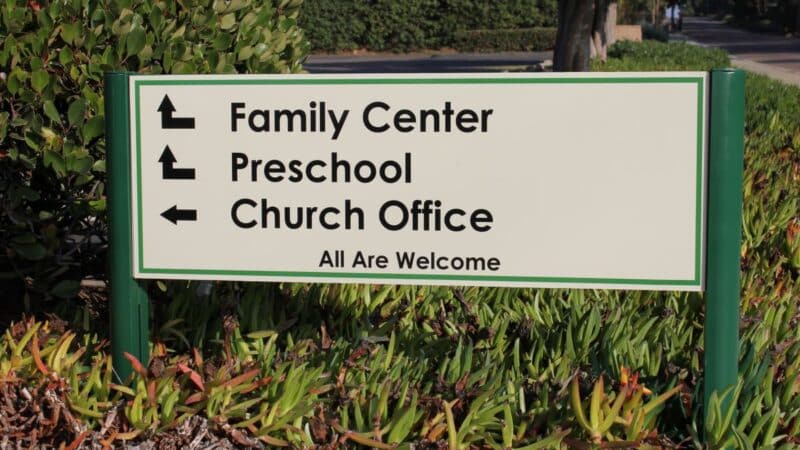
The church itself has been designed with a main-street theme. It's a long, narrow structure with exterior entrances to various ministry "store-fronts." Each ministry area—including the worship center, youth center, preschool, children's area and offices—features a different, brightly-colored façade, reminiscent of many Florida beachside developments, like the popular Seaside community. Palm trees, fountains and pavers are used frequently throughout the project.
An open-air courtyard in the middle of the building serves as the church's only fellowship hall. Varnado noted this wouldn't work in many areas of the country, but it is perfect for taking advantage of the coast's mild climate.
"Even though the weather tends to be windy, this area will be protected (since it is surrounded by the building)," Varnado explained. "It's also a safe place where children can play."
Hallways and corridors of the building are on the exterior, protected by trellises with acrylic tops, which offer protection from rain.
The facility's exterior is primarily synthetic stucco, which Varnado said is very typical for structures in Florida.
"It holds up very well to the weather and is economical," she said.
The building's base is constructed of split-faced concrete block, with the look of stone. This material is sturdier and better able to resist cracking in areas closer to the ground. A standing seam, metal roof covers all of the structure.
The 25,000-square-foot worship center is the largest part of the building, set to hold 500 seats in the first phase. Plans are to expand the worship center to seat 1,400 in the next phase. In the future, the worship center will expand to fill most of the current shell, with new construction housing preschool, children and youth ministries.
Many areas of the church, including the worship center, were designed as multi-purpose facilities. Only the preschool and children's areas were not designed as such, since whatever might be going on at church, there is likely to be a need for the children's area to be used for activities.
With thoughts in mind for future construction, the floor of the worship center is flat from the platform outward to a point, and then becomes sloped near the back. This will allow the church to easily expand the platform area in the future. It is useful now as well, since seating near the platform can be removed if needed for special programs. Banquets and other activities will be held in the worship center.
Planning ahead like this, Varnado said, is extremely important for churches looking into the future and planning for growth.
"The very first thing churches should do, if they have any thoughts of expanding or relocating, is to get a master plan," she said. "It's an overall road map for a church to follow, and it is important to have a vision of the big picture. Then you can slice it up into bite-sized pieces."
The team approach offered by firms working together, like Sparks Spiritual and Daniels & Daniels Construction did in this case, is an alternative to the traditional approaches most churches follow, either hiring only an architect or choosing a design/build company. In a way, the concept is a way of combining both situations and getting architects and contractors on board from the start.
The idea for the team approach is to provide clients with a seamless experience.
"We are not contractor-led or architect-led," Varnado said. "It's a team approach. We look for the personality of the church and move on from there. We want clients to express their feelings and materialize their dreams."
Sparks Spiritual, www.sparks-aei.com, and Daniels & Daniels Construction, www.churchesbydaniels.com, both Oklahoma-based firms with hearts for churches, joined together on this project to provide a master builder team. They can serve as architects, engineers, interior designers and builders on church projects. They also offer help in fundraising and financing.
In a Nutshell
Church: Living Word Family Church
Affiliation: Independent Charismatic
Location: Naples, Florida
Weekly attendance: 300 to 500 for Sunday services
Designers/Builders: Sparks Spiritual Division and Daniels & Daniels Construction worked together on this project
Project: Develop a master plan and design and build a new worship facility for this existing church, which is growing quickly
Size: 35,000 square feet
Cost: Estimated $6.4 million when completed
Challenge: The church purchased a long, narrow lot, 80 percent of which was part of a wetlands area. The design had to fit the lot and incorporate ways to reduce costs to compensate for the fees required for developing wetlands.
Solution: The structure was designed as an elongated mainstreet-type structure, with "storefronts" for different ministries. The structure will be built around an interior courtyard, which will serve as an open-air fellowship hall. Protected exterior hallways and corridors also will help reduce costs.