



Home About CSP In Every Issue Blog Archives Buyer's Guide Media Guide e-News Subscribe Contact
Check Out The
February 2012 Supplement


First United Methodist Church Jacksonville, Texas
By: Derek Watson

First United Methodist Church, located in Jacksonville, Texas, has a rich heritage in their community. Originally founded in 1845 at Gum Creek, the thriving church soon faced a dilemma—the whole town had moved away! In 1872, the railroad came and set up a station nearly 10 miles east of town. The people followed and formed a new town known as Jacksonville. It was at this time that the congregation chose to make their first major decision to relocate downtown, where the community they ministered to had migrated. The decision proved to be a wise one, and, in 1908, a grand worship facility was built in the heart of downtown. The church soon became a landmark in their community with its exquisite stained glass windows and towering façade, which overshadowed downtown commerce and residential growth.

To their surprise, it was the continued success and growth of the church that one day forced them to face another dilemma. They had overgrown their present location and were landlocked.  he thought of leaving their beloved facility was too much for many congregation members to even consider. It was under the light of these beautiful stained glass windows that they were brought up to fear God. The memories of baptisms, weddings, baby dedications and funerals were vivid in the minds of lifelong, faithful parishioners. Reluctantly, but with hope for the future, the church chose to acquire 20 acres of prime property on the south side of town bordered by a thriving community.

With great trepidation, the congregation voted to proceed with acquiring the services of an architect who designed a beautiful facility for them to move into at the new location.  The church began an energetic and hope-filled capital campaign and even began some dirt work at the new location to further solidify their resolve to relocate. When the time came to seek construction bids, the church was faced with possibly the greatest dilemma in its history. The bids to build their new facility came back $2 million over budget. Their dream for a new facility completely stalled for nearly two years.

One day, while passing through a nearby community, a First United Methodist church member decided to stop in on the construction site of a new facility for Evangelistic Temple in Palestine, Texas. The church member spoke with an on-site construction superintendent from Jacobe Brothers Construction, www.jacobebros.com, who listened to the story of the Jacksonville church and its problems in moving forward on their new facility. The construction superintendent recommended that the building committee of the Jacksonville church contact the architect on the Evangelistic Temple project, Ron Mabry of Ron Mabry Architects, www.mabryarchitects.com.

Since First United Methodist had already paid substantial fees to their previous architect, they were reluctant to meet with another architect. However, after meeting with Ron Mabry and Bryan Jacobe of Jacobe Brothers Construction,the building committee agreed to give them an opportunity to re-assess the original design.

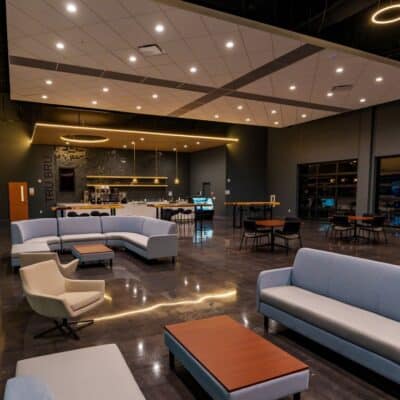
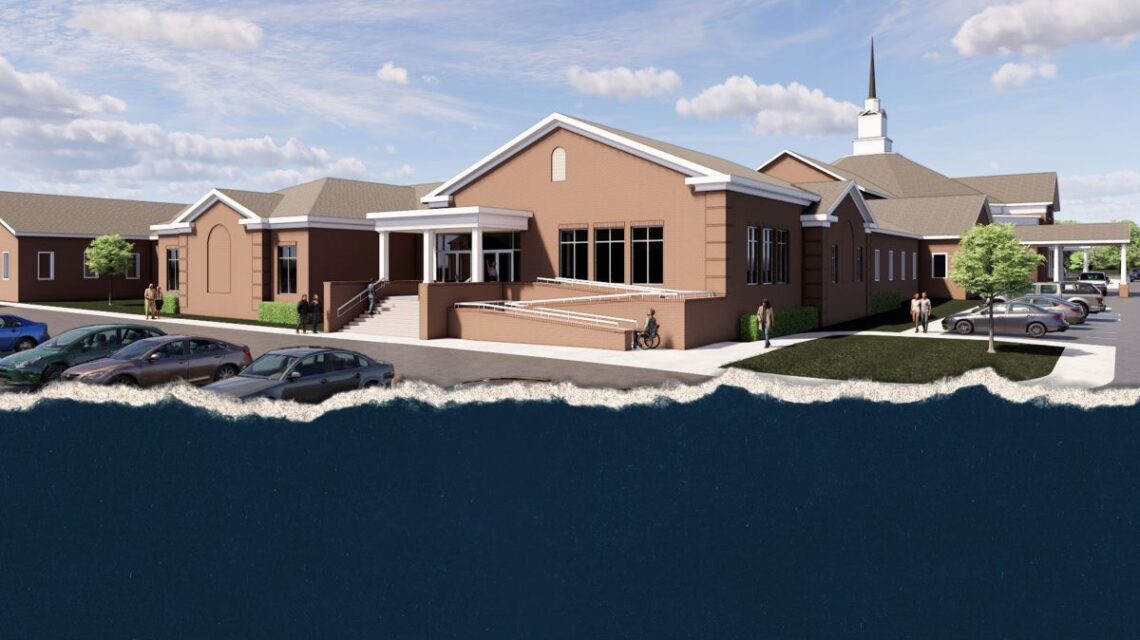
Together, Mabry and Jacobe were able to identify opportunities to improve overall construction costs on the proposed project. One of the issues that they addressed was the linear design of the proposed facility, which had produced nearly a half mile of exterior wall space. The strategy the Mabry/Jacobe team proposed was to design a central core rather than linear construction. In their new concept, the center of the building is a two-story atrium that includes a fireplace, comfortable chairs and sofas, and space for a coffee shop. The atrium is a place the congregation can gather before and after services, even in bad weather. Branching out from the atrium hub, like spokes on a wheel, are four building components: a children's nursery wing; administrative and adult education wing; worship and fellowship/ recreation. The new project was designed within the original budget without reducing the footprint of the original design requirements to meet ministry objectives.

While the church leadership was overjoyed with the prospect of resurrecting a stalled project, it was the decision to include the century-old stained glass windows in the new design that thrilled the congregation. Now they did not have to leave their old church behind; they could bring it with them. While the decision to include the cherished windows in a new facility was an easy one, the logistics of pulling off such a monumental task was not as simple.

Thirteen original windows valued at more than $500,000 were selected to be removed, restored off-site and relocated to the new location. The Mabry/Jacobe team selected Rob Foster of Foster Stained Glass, www.fosterstainedglass.com, for this critical task. 

Restoring stained glass windows is a six-step process:

1. Measurements and photographs cataloged in great detail

2. Removal of the windows
* In the sash (encasement)
* Out of the sash

3. Repairs
* Replace broken or mismatched glass with glass of same texture and color
* Flatten bowed sections and properly reinforce
* Address lead failure with total or partial re-leading of the window section
* Putty all sections on a flat, horizontal surface
* Clean the window sections of any extra putty on the surface of the glass

4. Installation of window sections into their proper locations

5. Final touchups

6. Installation protective coverings making sure to properly vent all coverings.

Mabry felt very deeply about what the church's historic stained glass windows symbolized to the congregation and the community. As a result, the church was designed so that the stained glass windows would be visible from all directions approaching the church.

 "This is their original church," said Mabry. "It just has a new facelift, new façade, new equipment and new location, but this is their roots. They brought it with them." 

Those roots are best depicted through the members' faith and the many cherished memories invoked by the church's stained glass windows.

Derek Watson is the director of business development for Ron Mabry Architects & Associates and Jacobe Brothers Construction. He works closely with pastors and building committees throughout the design and construction of their new facilities as the owner's contact and helps in vision planning, developing partnerships between the church and other entities, media relations, capital fundraising and the fostering relationships with lending institutions.

In a Nutshell

Church: First United Methodist

Location: Jacksonville, Texas

Project: Complete relocation of a 150+ year old church into a new facility

Size: 46,400 square feet on 20 acres of land

Challenge: Resurrecting a stalled project

Solution: Redesign of original architectectural plans and decision to bring century-old stained glass windows to the new location. More than a half mile of exterior walls was redesigned to create a central core approach as opposed to a linear design.


Voice Broadcasting

©Copyright 2012 Religious Product News
Religious Product News