



Home About CSP In Every Issue Blog Archives Buyer's Guide Media Guide e-News Subscribe Contact
Check Out The
February 2012 Supplement


Choosing the Right Playground for Your Worship Facility
By: Bob Robertson

Whether it's swinging from the monkey bars, tip-toeing across the balance beam, or shooting down the tube slide, there's nothing a child loves more than playing at the playground. For years, churches across the world have provided playgrounds for their families with young children. Below, we'll outline everything you'll need to keep in mind to build a beautiful, attractive, and safe playground for your community.

Choosing the right playground equipment for your church can be quite a task. At an average cost of $30,000 to $50,000, a playground is a significant investment. Forming a committee will allow people from different parts of your church to get involved in fundraising, planning, selecting the right company with which to work, and generally making sure that everything goes smoothly. The committee will focus primarily on three topics when choosing the proper playground setup: budget, use, and climate.

Playground Budgets
In large part, your playground budget will be determined by how many children you expect to use the playground at a given time. A good general rule is to budget for about $1,000 per child, meaning that if you expect 50 kids to be able to play there together, you should budget for about $50,000. Keep in mind that "themed" playgrounds will generally cost about 50 percent more than a normal setup. This money will cover preparation of the site, playground equipment and installation, safety surfacing (such as gravel or wood chips), potential costs of replacement parts for the first few years, money set aside against potential legal action, and first aid supplies for supervisors.

Generally, it pays to budget enough money to buy high-quality playground equipment. It is less likely to fail, meaning lower replacement costs and a lower likelihood of a legal suit, which could prove a financial burden to your church.

Churches often fundraise in order to meet their budget, but they may also look for partnerships with local schools or community groups that might be willing to work in partnership to build a bigger, more attractive facility. State and local governments may also provide grants for community development of this kind, so it's a good idea to check with your local authorities to see if you can further lower your net costs.

Who Will Use Your Playground?
After deciding on your budget, consider the age group that you expect to most frequently use the playground. This helps to figure out what sort of equipment will be best for your needs. If most of your kids will be from ages 2 to 5, for example, you'll want to make sure that no part of your playground is higher than 6 feet tall. Kids of this age love playing by themselves, and also love repetition, so things like digger sandboxes and swing sets may be good bets. You'll also want to avoid tube and spiral slides, as children of this age need to see where they're going in order to feel safe.

If, on the other hand, your children will be elementary school age (6 to 12), keep in mind that they like things that they can do together, such as parallel slides, climbing ropes, and poles will be popular, as will a setup that provides many different paths to the same location.

Churches that wish to appeal to kids of all ages should consider a combination of many different pieces of equipment, with signs posted to let kids and parents know which ones are appropriate for which age groups. No matter which age group you're looking to serve, be sure to consult closely with your chosen playground equipment company to find the setup that perfectly suits the needs of your church.

Now comes the fun part! After you've figured out your budget and who you expect to use your new playground, it's time to begin the search for the playground materials and options that are right for you.

How's Your Weather?
Choosing the right material for your playground can be a tricky proposition. Wood seems like a logical choice, but is it durable enough? Steel seems incredibly long-lasting, but is it too expensive? And what about synthetic materials and safety surfacing? Will they prove the most attractive option for your church?

After determining your budget and the age group you'd like to attract, it's time to think about materials, which will be dependent upon both your climate and the amount of use you expect your playground to see.

Generally speaking, playground equipment is made of the following three different materials.

1. Wood
Wooden playgrounds are less durable than those made of other materials and are susceptible to heat and water damage. Laminate or pressure-treated wood is more durable than untreated wood, but, even so, it will eventually require replacement. Wood is also subject to termite infestation. The nice thing about wood is that fixing a broken section often requires replacement of just a single board or post. Wood is cost-effective choice, suitable for low-impact, low-use facilities in cool, dry climates.

2. Steel
Steel playgrounds are highly durable in dry climates, but can be subject to rust in wet climates. In hot, sunny climates, they can also lead to contact burns for your kids. In recent years, polyvinyl coating has become a popular option for steel playgrounds, which helps to protect the structures from rust damage. This coating, however, can be torn through, and, in such cases, it's often an entire deck that rusts through, leading to expensive replacement costs. Steel playgrounds are suitable for high-impact, high-use facilities in everything from cool-dry to hot-wet climates, depending upon the quality of their polyvinyl coatings.

3. Fiberglass Reinforced Plastics (FPRs) and Synthetic Wood
Fiberglass reinforced plastic is a highly durable material that is suitable for many different climates. It is rust-proof, heat-resistant, and insect-proof, though it may crack with long exposure to hot sun or to harsh freeze-thaw cycles. Synthetic wood is made of recycled plastic and wood fibers, and it is much more resistant to weather than the natural variety. These choices are generally a bit more expensive than other materials, but have proven to be durable and attractive options for many high-use playgrounds around the world.

Lastly, consider the material you'll use to surface the area around your playground to keep your kids from getting unnecessary bumps and bruises. Woodchips and gravel are great natural choices, and may prove the most cost-effective option for churches. Keep in mind, however, that these materials may periodically need to be replaced or supplemented.

Other options include rubberized matting, artificial turf surfaces on top of foam padding (not recommended, as it may contribute to tripping), and "pour-in-place" rubberized surfaces, such as those you might find on a track. Pour-in-place surfaces are durable, resilient, and resistant to the elements, making them attractive choices for churches with room in their budgets.

Regardless of the material you choose, remember that (even in front of fun) the No. 1 priority of any playground is safety. Now that you're familiar with how to choose the budget and playground equipment that will be right for you, learn how to keep your kids secure.

Playground Safety Tips
It seems like being a kid and having bumps and bruises go hand in hand, and many of those boo-boos can come from playgrounds. With proper precautions and supervision, however, playgrounds can be a wonderful boon to a church. Jungle gyms and other kinds of equipment are a wonderful way to attract younger families and provide a hands-on way of guiding and teaching the children of your community. Are you doing all you can and should to make sure your kids are safe?

The most important part of playground safety is supervision by competent, attentive adults. A good general rule is to have one adult for every 20 children, though this ratio may need to be adjusted if the group is composed of special needs children or those who are particularly rambunctious.

Some churches benefit from making a supervision plan or list of rules for the playground. This list should include suggestions of the children and should be reviewed with the group as a whole to make sure everyone understands why the rules are in place. Keep in mind that children below the age of five will remember between two and four of your rules, on average, while older children may remember five or more, so make your most important rules the first few on the list.

Supervisors should be trained in first aid and should have a well-stocked first aid kit available to use in case of emergency. For reasons of liability, if a child is injured, an accident report should be filed each time. These reports should identify the child, give the details of the incident, and identify the piece of equipment that contributed to the child's injury.

There are lots of ways to make a playground safer, and many of them are easy to implement. Playgrounds that are on hard surfaces—such as concrete, packed dirt, or even grass—may contribute to children's injuries. Think about adding soft, weather-resistant rubber padding, gravel, or wood chips to help reduce the likelihood of a child getting hurt in a fall.

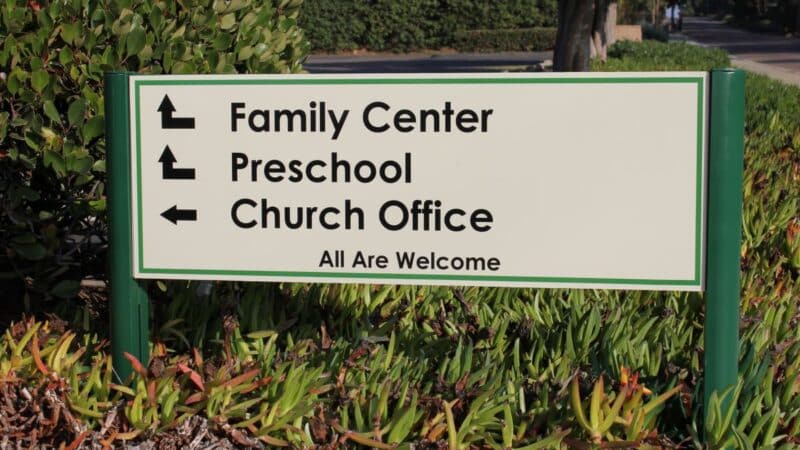
In the same spirit, do your best to minimize tripping hazards around the playground; this is one of the most common ways to skin a knee and will save your kids lots of bumps and bruises. Additionally, post signs which let kids know which equipment is appropriate for their age group, through both words and pictures. This is one of the easiest and least-utilized ways to help keep your kids safe.

In terms of the playground equipment itself, make sure that everything is in proper working order before allowing a child to play on it. Inspect wood and steel for cracks and rest, and periodically check fasteners to make sure that they haven't come loose. Metal fasteners should also be recessed so that they don't snag on children's clothing and cause falls. Ropes should be secured at both ends to reduce risks of choking and asphyxiation.

Never use residential playground equipment for your church's playground. In the result of a catastrophic failure or severe injury to a child, it could lead to harsh liability penalties that might spell financial disaster for your organization.

For more information on playground safety and ways to keep your kids safe, consult with your playground manufacturer and playground surfacing companies, both of which can easily be found through a quick online search. Additionally, the National Program for Playground Safety and the U.S. Consumer Product Safety Commission may be able to offer more extensive information on how best to protect your children from the bumps and bruises that don't have to come with being a kid.

This article is courtesy Bob Robertson of FaithClipart.com, a Web site dedicated to helping churches achieve excellence in their Christian message.

Product Roundup

GT Jams by GameTime
Based on traditional African and Caribbean instruments, GT Jams features a series of tonal and rhythmic instruments that can be incorporated into a play system or used to create freestanding musical stations. As children of all abilities play together to create their own music, GT Jams encourage:
* Creativity
* Physical movement
* Self esteem
With a variety of drums, shakers, scrapers, and tonal instruments to choose from, you can structure a Jam Session that kids will find irresistible.
www.gametime.com

BCI Burke's Intensity
BCI Burke's all-new Intensity fitness play complex is designed to stimulate and exercise the young bodies of 5-year-olds and up, while providing so much fun that kids won't want to go home. And, Intensity will get kids moving to keep them healthy, deterring obesity and inactivity. They'll be so engrossed in the challenge and excitement that they won't realize they're doing great things for their bodies. Intensity features:
* 5" posts
* The popular and proven Burke bolt-through fastening system
* Maximum play value with deckles designs
www.bciburke.com/intensity

SofSURFACES
SofTILE KrosLOCK has been engineered and thoroughly tested to meet the stringent requirements of today's most sophisticated safety surfacing consumer. Surfaces feature:
* An enhanced locking design to ensure that SofTILE locks in place and stays in place
* Increased density that achieves superior attenuation ratings
* A 10-year warranty for materials and workmanship
SofSURFACES impact attenuation performance complies with the latest standards for 10 years.  
www.sofsurfaces.com

Evos from Landscape Structures
Evos playsystem from Landscape Structures exerts a gravitational force on kids' urge to play. With Evos, play is possible in every direction, and no two play experiences are ever the same. Evos play events:
* Build physical strength and agility
* Develop spatial awareness and balance
* Increase coordination and problem-solving skills
Because of its circular footprint, Evos can be oriented in any direction to fit just about any play environment.
www.playlsi.com

Endura from Advanced Ground Care
Put it down and forget about it—there is no need to replace Endura synthetic ground cover year after year. Made from 100% recycled rubber, Endura is the choice for both playground and landscaping applications. Endura:
* Won't blow or wash away
* Is warranted against fade and total color loss for eight years
* Discourages weed growth and rodent/insect infestations
Endura groundcover and mulch products are available in several colors (including cedar, redwood, and blue) and a variety of bag sizes (one cubic foot to bulk).
www.advancedgroundcare.com

International Play Company
International Play Company designs, installs and manufactures indoor play structures and outdoor commercial playgrounds for churches. Make your church more dynamic than ever for young members. IPC is dedicated to creating customized play systems to meet your space and budget requirements. Create a play environment in a style to suit your church, including:
* Noah's Ark
* Tree House
* Jungle Safari
They adhere to ASTM, CPRA, IPEMA safety guidelines and have in-house playground safety inspectors.
www.iplayco.com

Play Mart Safe Surfaces
Play Mart offers a wide variety of safety surfacing options to provide a safe play area for the company's recycled plastic play systems. Surface options include:
* Loose-fill (shredded rubber or engineered wood fiber)
* Solid (rubber tiles or poured-in-place rubber)
* Rainbow of color choices for coordinated color schemes
* Shredded rubber (recycled tires) safety surfacing combined with the exclusive Recycled Plastic Play Systems (100% recycled HDPE - milk jugs) for a completely "green" play area
www.playmart.com

Navajo from Progressive Design
Progressive Design's popular Navajo structure for children ages 2 to 5 comes with an optional integrated shade. Instead of buying play equipment and a shade structure separately, you can cut your costs by buying the Navajo with integrated shade. 
* The Navajo packs a lot of play value in a space-saving design.
* It has been very popular with churches looking to maximize their playground budget. 
* The integrated shade is also available on many other models.  
www.pdplay.com

Noah's Ark from Romperland
The "Noah's Ark " structure from Romperland's Adventure Play series uses smaller decks and posts to accommodate a variety of play components.
* All components are made of the same durable, high-quality products as Romperland's Ultimate Play series.
* Direct bolt connections allow for exact installation, and tamper-proof, stainless steel hardware reduces maintenance time and costs.
* Freestanding or in-ground installation is available to accommodate all site conditions. The philosophy of innovative and value-driven design along with uncompromising commitment to quality has made Romperland a leader in the playground industry.
www.romperlandplay.com


Voice Broadcasting

©Copyright 2012 Religious Product News
Religious Product News