



Home About CSP In Every Issue Blog Archives Buyer's Guide Media Guide e-News Subscribe Contact
Check Out The
February 2012 Supplement


Fellowship Bible Church - Little Rock - Arkansas
By: Jennifer-Walker Journey

The 5,000-plus members of Fellowship Bible Church in Little Rock, Arkansas, knew their church was special. As the congregation grew and diversified, the church branched out to meet the varied needs of its members.

Its campus grew to house three separate worship services – contemporary, traditional, and a blended service. Each of the three concurrent services had its own worship style with separate pastors to deliver opening remarks and different types of music. However, all three tuned into the same pastor's message, which was delivered live in the main worship hall but beamed out on big screens for the traditional and contemporary services.

The multi-venue worship experience is a relatively new practice in a handful of churches nationally, but it is gaining in popularity. The multi-venue approach provides a more comfortable, community-like environment for the thousands of members of substantially large churches, according to John Denny, Fellowship's campus director.

In Fellowship Bible Church's situation, instead of all of the members piling into a large auditorium for the same experience with limited visibility, members can pick and choose the type of service they want in a cozier environment. The three smaller venues offer more opportunity for personable, small-group fellowship among members, while allowing members who attend separate services to be able to discus the day's lecture together.

The setup at Fellowship Bible Church was almost ideal. But, the strains of growth were beginning to show. The contemporary service was squeezed into the church's gym, and to get to the children's building, one had to cross a four-lane road. Furthermore, the separate venues were almost too separate. The only common area for members of all worship venues to see each other was in the church's parking lot.

"It's just not ideal to congregate in a parking lot. Here in Arkansas we have cold winters and hot summers," Denny said.

The need to either expand or move to a new location was slowly creeping into the minds of the church leadership. When the thought was not quite ripe in their minds of the elders, they were approached with an offer by the neighboring private school. The school and church often shared facilities, especially as both grew in attendance over the years, with the church allowing the school's graduation ceremonies in its worship center and the school offering its parking lot for large church events. When the school presented its offer to purchase the church to the elders, they readily accepted.

"It was a good offer," Denny said. "It was accepted by the elders before we knew where we were going, even before we had land."

The church was given two years to vacate its current facility, and so it took immediate action to do in two years what most professionals told them would take at least three.
The perfect plot of land, located just a few miles from its current location in the middle of a residential area where many congregation members lived, came available almost by chance. It had been eyed by developers in years past, but the owners did not want to sell. Miraculously, when Fellowship Bible Church began searching, the property suddenly came on the market.

"It was really God's work," Denny said.

Fellowship Bible Church built its design and construction team early, hiring Wilcox Group Architects, based in Little Rock, to design the new campus. The firm's portfolio focused mostly on higher education and healthcare facilities, said Wesley R. Walls, AIA, president of Wilcox Group Architects.

"It is our understanding, through later conversations, that our emphasis on design/creativity and – ironically – the fact that we had not done a lot of religious or sacred architecture appealed to the selection committee," Walls said. "They wanted a creative design team who would think outside the box."

And that's just what Walls and his team did. The campus was designed relatively contemporary in form and archetype.

"Fellowship Bible clearly conveyed that they were not about 'high church' and were more intent on projecting an image of a progressive, community-focused ministry," Walls said.

Thus, the design team set to work on what is likely the only church designed at its onset to be a multi-venue facility.

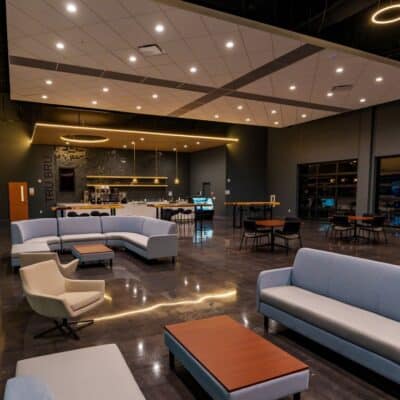
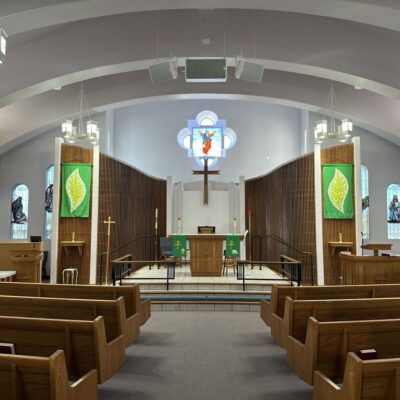
The 195,000-square-foot facility was designed to meet all the church's varied needs. The 1,400-seat worship center is the venue offering the blended service with the live sermon. The 800-seat warehouse, called The Edge, is the venue offering the contemporary service. And, the 400-seat chapel is the venue offering the traditional service. Each venue offers a different style of music and a different décor to match the worship style.

Fellowship Student Ministries also contained its own 400-seat worship venue in addition to activity and pre-function spaces. The campus also includes a large, themed children's component with indoor and outdoor playgrounds, two cafes, a bookstore, administrative offices, a small glass chapel, and an outdoor amphitheater.

Denny best describes the campus like a mall with a large plaza that opens into the different worship venues.

A key part of the church's construction was the audio-visual component, which needed to be seamless and state-of-the-art in order to transmit the sermon live to its other venues. For this, a $4 million was budgeted. More than 50 miles of audio wire was used in installation to connect more than 230 speaker cabinets, five large-format digital consoles, and seven digital AV mixers.

"Center and side screens create a very close and personal feel in the alternate venues," said Gwin Edwards with American Audio, Inc., of Ruston, Louisiana, the company that installed the audio-visual equipment, with Mission Service of West Monroe, Louisiana, providing the video integration. Acoustic Dimensions of Dallas designed the system. "The center screen in these venues is typically 8 feet to 10 feet tall and nearly 20 feet wide, allowing for a larger-than-life appearance to the video pastor."

Two years after its original building sold, Fellowship Bible Church opened its doors and held its first service on May 18, 2008, to an audience of nearly 6,000 people.

 "On the first day, when most people saw the new building for the first time, a lot of them said it feels like home already. And that's what we wanted. We wanted comfort," Denny said. "This new campus has given us the community that had been so missed."

The Wilcox Group Architects is a 25-person firm that strives to demonstrate an effective combination of design excellence, environmental stewardship, and client advocacy, www.thewilcoxgroup.com.

In a Nutshell

Church: Fellowship Bible Church

Location: Little Rock, Arkansas
 
Congregation Size: More than 5,000 members

Project Goal: Build a multi-venue worship center

Size: 195,000 square feet

Construction Cost: $38.4 million

Challenge: The church sold its property to a neighboring school and was given two years to find land, design a new campus, and complete construction. 

Solution: The church immediately set to work, hiring an architecture firm and contractor who understood the need for an accelerated construction schedule without cutting corners in the process.


Voice Broadcasting

©Copyright 2012 Religious Product News
Religious Product News