




![]() |
||||||||||||||||||||||||||||||||||||
|
Making Front Projection Shine in High Ambient Light
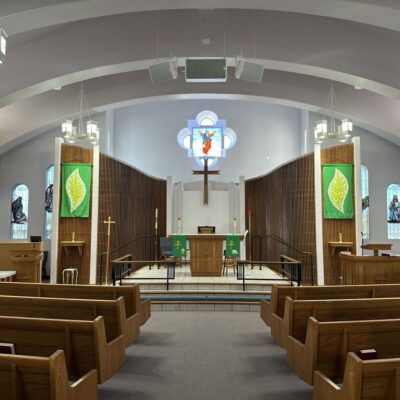
By: Jenny Brust and Joe Baer In an era where new visual technologies are seemingly around every corner, it's no surprise that houses of worship are increasingly using such tools to enhance the quality of their services. While the trend is more pronounced in large churches, just over half of congregations with weekly average attendance of 100 or fewer have indicated they used some form of projection technology on a regular basis. Projection can be a visually stunning choice for presenting text, still images, movie segments, or video clips. It is also considerably more cost-effective and easier to install than other visual media alternatives – such as plasma, LCD or LED – in sizes at or above a 100-inch diagonal screen. But, the typical house of worship was not designed to optimize display images. The house lights and ambient light flowing through skylights, large stained glass windows, or window walls can spell trouble for projection technology unless church leaders take a thoughtful approach to their multimedia needs. For houses of worship that are ready to install large screen projection – or upgrade an existing system – the following six-step assessment process can help ensure high-quality results where ambient lighting is an issue. 1. Management of outside light sources 2. Management of indoor light sources 5. Screen selection and sizing In terms of sizing, a handy guide for most houses of worship is the "rule of eight." For example, if the most distant viewing area in the sanctuary is 80 feet from the desired screen location, the screen should be no more than 10 feet high. Conversely, there is an ideal 1:1 ratio to measure the distance between the projection screen and the nearest seating. That means if the closest worshippers are 15 feet away, the screen should be no more than 15 feet wide. 6. Projector selection and image brightness When evaluating projection needs, a professional integrator will typically take a series of lux (light measured in foot candles) readings. This will measure light reflected off the screen under normal worship service conditions, as well as reflected light in selected viewing locations in the sanctuary. This will help determine how much ambient light the projector needs to overcome. As a next step, the integrator will calculate the screen size and gain to help determine how much lumen output is needed to deliver appropriate image clarity. Since new screen technology can so effectively capture light from a projected source and reproduce uniform images while rejecting ambient light, projector costs can be dramatically reduced. High-powered projectors are simply not required with the proper high-contrast screen. Now church leaders can capture their audience with stunning large displays while keeping the house lights up. Optical screen gain is critical in projector selection. For example, assume a 12x9 foot screen with a gain of 1 needs a 10,000-lumen projector to achieve the proper brightness. On the other hand, a digital front projection display that produces high image contrast and no decline in off-center brightness can deliver superior visuals with a much less expensive projector. By following these six steps, technology leaders in houses of worship can maximize the rewards of today's front projection technology without sacrificing the aesthetic value ambient light brings to each service. Jenny Brust is business development manager for AccelerOptics, www.capturedisplays.com. Joe Baer is regional vice president of AVI Systems, www.avisystems.com. |
| ||||||||||||||||||||||||||||||||||