



![]() |
||||||||||||||||||||||||||||||||||||
|
|
Building Blocks for Stadium Seating Design
By: Frank B. Moson As worship facilities expand traditional services to incorporate more live entertainment, including music and theater in their message to parishioners, seating, acoustics, and visibility of the "stage performance" have become primary design criteria in new sanctuary architecture. Key to an interactive environment inherent in new worship center designs is a clear view of the presentation. Witness the home of Lakewood Church in the former Compaq Center (prior home to the Houston Rockets). Although the 16,000-person capacity of this church is an extreme example, it makes the point that stadium seating in worship facility design has come of age. Today's generation of progressive mega-churches are designed to accommodate large congregations and stadium-style tiered seating in the sanctuary. With the advent of stadium-style seating comes a variety of opportunities pertaining to the design of the stadium risers. The incorporation of elevated stadium seating can: * Enhance sight lines to the pulpit Worship facilities being constructed nationwide with seating capacities of 1,000 to 5,000 typically incorporate stadium-style seating toward the back of the sanctuary. The design of the stadium risers fanning out along the back of the sanctuary is typically penetrated at several key circulation points, thus allowing the congregation easy access to both the tiered seating platforms and the floor seating toward the front of the space. EPS Geofoam Building Blocks Developed as a pre-engineered "kit of parts" for stadium seating risers, the EPS Geofoam Systems incorporate blocks of EPS cut to the dimensions of the stadium seating platform and stacked like building blocks to form the profile of the tiered seating risers. After the blocks are put in place, the permanent steel forms are placed along the face of the risers and secured with steel "retainer" hardware. Then, the prefabricated steel forms for the intermediate steps are secured to the vertical face of the risers to complete the "bones" of the system. Last, as a finishing floor material, the concrete horizontal surface of the stadium platforms and the intermediate steps is poured in place directly on top of the EPS Geofoam blocks. Design Flexibility Space Under the Platforms In this case, the rooms are constructed in a traditional manner with steel stud and drywall construction with lightweight steel joists spanning the area of the "tuck-under" space. A structural steel deck is then used to top the interior structure and serve as a secondary structure for adding EPS Geofoam blocks and risers for the upper platforms. Balcony Seating Ramps and Stages An Environmentally Friendly Solution Economical, Fast, and Easy to Install Getting Back to Basics Frank B. Moson is the owner and chief executive officer of Stadium Seating Enterprises, Inc. (SSE), based in Laguna Niguel, California, www.stadiumseating.com.
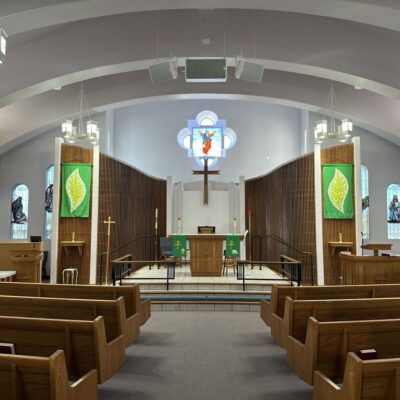
A primary concern for many churches contemplating seating options is, “Which type of seating is the most space-efficient option?” It depends first on how the space will be used. If it is a multipurpose space, then movable seating should be used. If the worship center is dedicated to just worship, fixed or movable seating are options. If planned correctly, auditorium seating can accommodate up to 20 percent more than pews. Research shows that human nature will stop someone from sitting right next to a person that they don’t know without any boundaries or divisions, which is why pew seating isn’t always the best option for fitting the most people in a sanctuary. It is more common for people to climb over others to get to a middle seat in auditorium seating rather than pews. With so many options to consider, it is hard to know exactly what is right for your church. How do you decide? Who should be involved in those decisions? What are all of the factors that you should consider? A church building committee that represents a microcosm of the church is invaluable in this process. People who will experience church services from the pulpit and in front of the pulpit need a say in this process. Church members know the most about what the congregation needs; they witness each of the areas of needs weekly. Don’t forget to draw on the experience of those who deal with these issues daily. An experienced design team consists of the people who know what a reasonable lead time is and the pricing process for your particular seating. The design team is experienced in understanding building code requirements and the capacity of the space, and can serve as an experienced guide while leaving the choice up to the committee. Allow them to direct and advise you about such considerations as sight lines to the pastor and projection screens. They will know if traditional linear seating will work, or if radial seating will be required for optimum viewing and hearing. For multipurpose spaces, adequate storage for chairs and handicap accessibility can also be overlooked or underestimated without consulting those experienced in space planning. Do not hesitate to tap into the knowledge of the designers to find out about new innovations or seating trends that can optimize your budget and flexibility. So, what are some of the trends and innovations that need to be considered or employed in the selection of seating? Innovations are always being made by manufacturers and designers. Recently, auditorium seating that is gravity sensitive is a big trend. This modification allows for quiet, easier entrance and exit from the seats during a sermon. Also an innovation in auditorium seating is how manufacturers have reduced depth of the seats when in the closed position without sacrificing comfort. This allows for the rows to be closer together, because the chairs require less space. Another type of seating to consider is a pew with individual cushions vs. one long cushion over the entire pew. This gives that necessary separation between individuals, but still maintains the formality of tradition of pews that some churches require. It helps to consult someone that knows about the latest and greatest product lines, because they can drastically increase the capacity and performance level of your seating. Fabric choices are continually changing and improving. This is a key area for a church that needs to make the most informed decision to maximize durability and, ultimately, the budget. For upholstered seating, there are always new fabrics out there that will stand the tests of time better than the rest. Terms such as “double rub” and “crypton” might not mean anything to the typical person, but, to a designer, those terms can make or break a fabric choice for a church. Designers recognize that a church will most likely change their carpet before the seating fabric, so the fabric choice needs to extend over particular color trends and have a durability level that will last. The lifecycle of your seating can weigh significantly in the decision-making process. Wooden pews usually last for 50+ years and have approximately a 25-year warranty. Auditorium seating and chairs typically come with a 10-year warranty. If the right decisions are made, your sanctuary seating can last as long as it needs to with minimal maintenance or cost. Selecting attractive, comfortable, and functional seating shouldn’t be overlooked. With the correct seating selection, the experience of a worship service can be remembered for all of the right reasons. Good seating then becomes a tool to welcome and reach people. Paulla Shetterly is an associate principal at CDH Partners, Inc. in Marietta, Georgia, www.cdhpartners.com. |
|
||||||||||||||||||||||||||||||||||
|
||||||||||||||||||||||||||||||||||||
|
For Christian School Products, Reviews And Resources Visit The Christian School Products Website |