

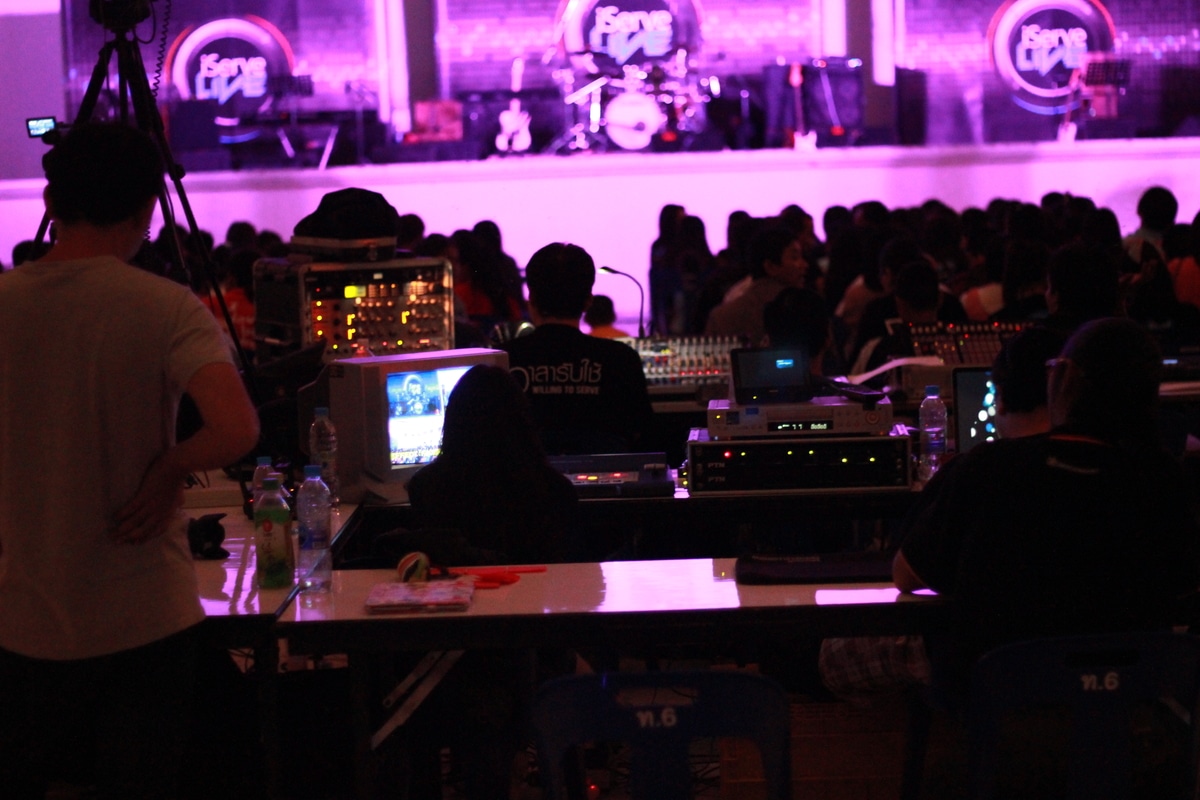
In recent years, hybrid worship has become a lasting part of church life rather than just a temporary fix.
Congregations now look for ways to connect both in person and online, and churches are tasked with designing audio-visual (AV) systems that create an engaging, seamless experience for everyone.
When many churches focus on technical capabilities, they often overlook the importance of the volunteers who operate the AV system each week. Designing volunteer-ready AV systems that combine reliability, ease of use, and a strong digital foundation is essential for thriving in the hybrid worship environment.
- The Power of Digital Audio Networking (Dante)
Traditional analog audio systems often face limitations with cable runs and channel counts. Dante (Digital Audio Network Through Ethernet) has transformed audio distribution, making it much more flexible and reliable. With Dante, multiple channels of high-quality, uncompressed audio can travel over a single network cable, reducing clutter and making setup easier.
Dante makes it possible to send different mixes to front-of-house, broadcast, and other rooms and spaces without extra analog cabling or any loss of signal quality. Configurations can be saved, recalled, and adjusted easily, so the system can be pre-set for different types of services or special events. If adjustments are needed, returning to a previous setup takes only seconds, making things easier for volunteers to operate.
Dante integrates with most modern digital consoles and stage boxes, supporting easy scalability as ministry needs grow. New inputs, outputs, or even additional rooms can be added to the network with minimal changes. This plug-and-play flexibility is especially helpful for churches with multiple ministries and rotating volunteer teams.
- AV-over-IP: The Backbone of Hybrid Media
With video production and streaming now essential to worship, AV-over-IP (Audio Video over Internet Protocol) has taken the place of traditional HDMI or SDI matrix routing in many church systems. AV-over-IP allows video and audio signals to travel over standard network infrastructure, making centralized control, long-distance routing, and efficient signal management possible.
This technology results in fewer physical connections and greater flexibility. Cameras, encoders, displays, and projectors all connect to the same network. With the right configuration, any source can be routed to any destination with just a few clicks.
AV-over-IP also delivers ultra-low latency and lossless video, which is essential for live worship where timing matters. Maintenance is also simplified for volunteers if a display or encoder needs replacing, the system recognizes the new device once it’s connected to the network, reducing downtime and complexity.
- Digital Consoles: Recall and Scene Memory
Digital mixing consoles are now at the heart of modern worship spaces. In addition to delivering excellent sound quality, their biggest advantage is scene recall, the ability to save, retrieve, and update entire system configurations with ease.
For instance, one scene might be set up for a Sunday service, another for youth night, and a third for special events. These functions simplify the operation while ensuring consistent sound quality no matter who is operating the board.
Modern consoles often integrate seamlessly with Dante networks, so broadcast mixes can be managed separately without complicated patching. User profiles can also be created with custom permissions, ensuring volunteers only access the controls they need and reducing the risk of accidental changes.
With a well-tuned room and properly set gain structure, a digital console makes even complex systems approachable for less-experienced volunteers.
- Making Operation Simple for Volunteers
Even the best technology only matters if people can actually use it. In many churches, the production booth is run by dedicated volunteers. Designing a volunteer-friendly AV system means thinking beyond specs and gear, it’s about creating an environment where volunteers feel confident and capable.
Proper labeling and integrating intuitive action buttons like “Start Stream,” “Activate Lights,” or “Service Scene” are very helpful. Clear labeling, well-organized workflows, simplified button and automations are just as important and help minimizing mistakes and easy operation.
Training and rehearsal should also be part of the routine. Even with simplified technology, volunteers need space to practice, learn, and get comfortable.
- Designing for the Future with Audiovisual Integrator
Technology keeps moving, but a thoughtfully designed AV system should serve your church for many years. When planning renovations or a new installation, it really pays to consult with an audiovisual professional who has hands-on experience and knows the ins and outs of church environments. Focusing on network-based solutions, scalability, and maintenance from the start makes the system easier to manage as church’s needs grow.
Hybrid worship isn’t just about streaming. It’s about bringing the whole congregation together, whether people are in the room or joining online.
By building systems around Dante-enabled networks, AV-over-IP infrastructure, digital consoles with scene recall, and volunteer-friendly PTZ cameras, churches can create AV setups that are reliable, flexible, and easy to run.
The goal isn’t to make worship more complicated with technology. It’s to make sure technology serves worship, not the other way around.
When systems are intuitive, volunteers feel confident, creativity flows, and the church’s message can reach farther than ever before.
This article is courtesy of EIDIM, which stands for “Everything Is Done In the Maker.” EIDIM specializes in all aspects of the audiovisual world, such as consultation, integration, procurement, maintenance, and more, www.eidim.com.