

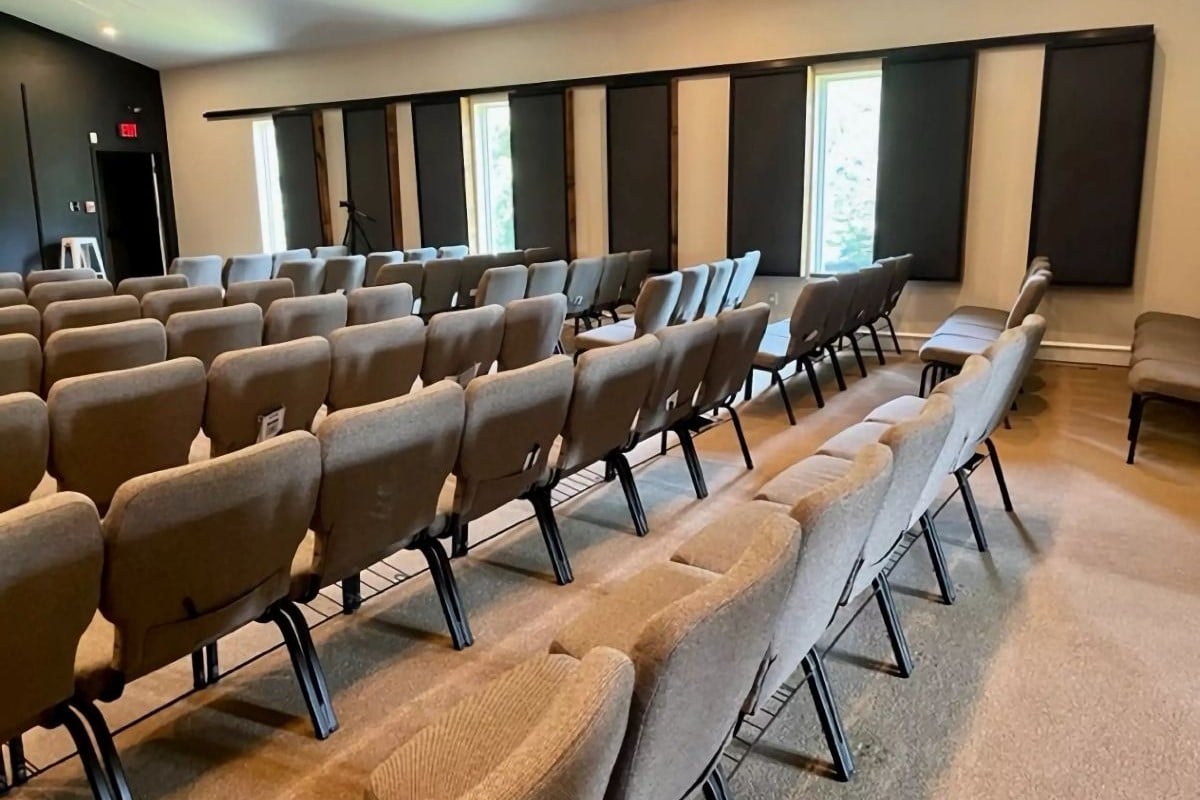
The largest acoustical issue in churches is called reverberation. Reverberation is defined as to how long a sound stays around within a room after it has been sung, spoken, or played. One could say that the sound energy has overstayed its welcome.
Reverberation is caused by the reflections of sound energy off of the four walls, floor, and ceiling. Every surface area contributes around 17% to the overall reverberation issue. All walls and ceiling along with the floor turn into huge energy reflectors that must be treated in order to lower the strength of the reflection itself. To manage reverberation, we must minimize the impact those reflections have on our hearing.
We have two types of energy in our churches. We have the direct energy from speakers and sound reinforcement technologies used inside the church. The energy that travels in a straight line from the speaker to our ears is called direct energy. It is the most resolute of all sound energy since it travels in a straight line from the speaker to your ears without the reflection impact of the four walls, ceiling and floor. This direct or straight line energy does not contain reflections and is considered the purest of all sound with the highest speech intelligibility qualities.
If we could survive on just direct sound, we would not need to have a discussion on reverberation or reflections. Unfortunately, once the direct sound leaves our speakers, it travels to our ears, but it also travels to the walls, floor, and ceiling. The reflections from the walls and ceiling mix with the direct energy. This combination of direct and reflected energy strikes our ears at different times. The reflections arrive behind the direct wanted sound. This confluence of energies confuses our human hearing systems.
This confusion minimizes our ability to hear both speech and music intelligently. Speech intelligibility is defined as to how many words one can hear in a 10-word sentence. In churches, with both the spoken and musical word, you want to achieve a speech intelligibility index of above 80. We need to hear at a minimum of 8 words out of every 10 spoken. Our brains will fill in the missing 2 words. To achieve speech intelligibility index numbers higher than 80, we must reduce the strength of the reflections from the walls and ceiling.
TREATMENT
We will use sound absorption technology that focuses on the 125 – 500 hz. frequency range. In order to achieve a high speech intelligibility number, we need to lower reverberation times down into the 1 – 1.5 second range. We will also use the correct amount of treatment on each room surface area. Our goal will be to lower reverb times, which in most churches is over 4 seconds down to 1 – 1.5 seconds. This number is referred using Rt – 30 / 60 times.
To manage the reflections, we must treat the frequency range of those reflections along their amplitude or strength. We will use sound absorption to lower the strength of the reflections along with addressing the most critical frequency range for reverberation, which is the 125 hz. – 500 hz. frequency range.
We must focus on this frequency range of energy, but, just as important, we must absorb at least 75% of that energy with any chosen technology. This is where most fail. They choose the most economical without consideration for the performance of the treatment. If the treatment doesn’t have enough horsepower, you will never hit your numbers no matter how much you spend.
Not all sound absorption technologies are the same. When you are treating reverberation, you must choose the correct type of treatment, but you must also cover enough surface area with treatment to reduce the strength of reflections from each room surface area.
Most churches fail in both of these areas. They choose the wrong technology, and they never place enough to achieve a number goal. It is probably just as well since the technology chosen doesn’t have a scientific chance of achieving a proper speech intelligent goal.
When you focus on reverb treatment, you must break the four walls and ceiling down and treat them as separate “rooms” within the church. Let’s start with the floor first. The floor is responsible for 17% of the overall reverb issue. We will treat the floor issues using human beings. Every church member is the equivalent of 12 sq. ft. of 1/2″ carpet with a 1/2″ pad. If we have 100 congregation members, we have 1,200 sq. ft. of treatment on that surface area. Our projects show that, in most cases, the people cover enough surface area; we don’t have to spend money treating the floor. However, now we must treat the four walls and possibly the ceiling.
We look at room size, amount of energy placed within the room, speaker size and position. And, we look at each wall surface since each wall surface is different in frequency and amplitude of issues. Once all of the variables are considered, we can prescribe the treatment type along with the square footage of coverage each wall and ceiling surface will require. Size and positioning of treatment will need to be calculated.
DIY PROGRAMS
Treating reverberation in larger venues is expensive and requires that you cover between 35 – 65% of each surface area. We try to treat the issues using the four walls to avoid a ceiling installation. We are successful in 50% of those project types. To lower labor costs, we find that most churches will have a congregation member or members that will be willing to build the treatment type and contribute their labor towards assisting the church. This team effort can reduce overall project costs by 40%. We do the design and send you the drawings and material list. The sound absorption technology is purchased, and church members would build and install.
Dennis Foley is the chief acoustical engineer at Acoustic Fields. To begin the DIY process, visit their website and fill out the information in this link, www.acousticfields.com/free-room-analysis.