


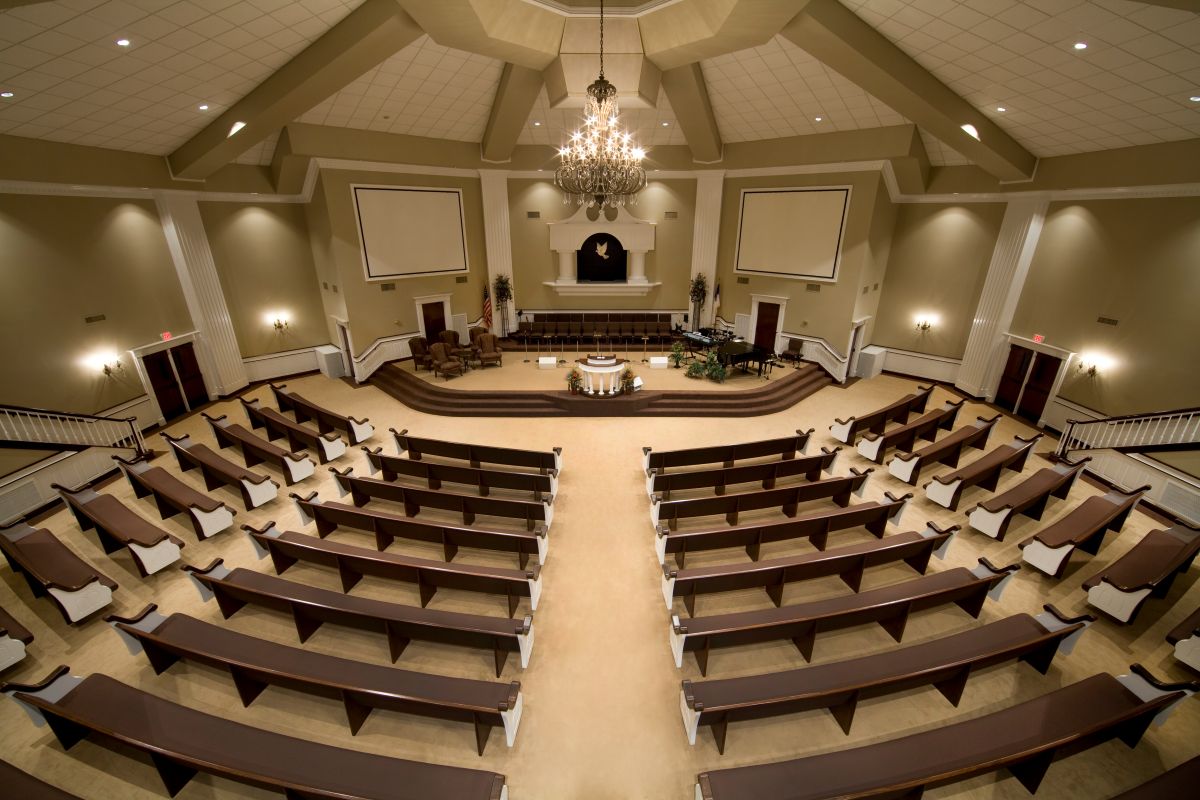
When choosing seating for a new sanctuary or for a complete remodel, the focus often stops at selecting the type of seating, such as pews, theater style chairs, stacking chairs, etc. Perhaps even more important than the type of seating selected is the layout of the seating itself.
When a person goes to church, he or she is seeking connections with God and with other believers. Though all buildings are unique, the arrangement of the seating should create community among the congregation and also connect the congregation to the message (via the speaker) from God’s Word.
First, let’s look at some ways that the arrangement of the seating can help build community among the individuals who worship in the church building each week. Community among members is built when connections are made, which will typically be a combination of physical, spiritual, and emotional connections.
Many studies have shown making eye contact will deepen the connection between two people. In a worship setting, the seating plan should facilitate eye contact between individuals within the congregation and also between the speaker and the congregation. So, for maximum impact from eye contact, the seating should be arranged so that a congregant has a clear line of sight to the speaker, as well as a large portion of the congregation.
Traditional Design
Comparing two different scenarios, let’s first look at a traditional design for a worship setting. Picture a simple, rectangular worship space, with the platform (and possibly choir) at one end, facing towards the congregation on the opposite end.
This traditional design resembles two football teams facing off against one another more than a group of people coming together to worship the one true God. Those seated in the front rows will have good eye contact with the speaker, though those in the back rows will have diminished eye contact, if any simply due to distance.
In this design, community among members is limited to those in very close proximity to one another. Since all congregants are basically lined up facing the platform, it is much like sitting at a long, rectangular table with 25 people to share a meal. Once you sit down, you can only see and hear the person on each side of you. The rest of the people you can’t see, probably can’t hear, and will share virtually no interaction or connection.
While this traditional plan scores only moderately well on the community aspect, it scores very well on getting maximum seating capacity out of the available space. So, while the quality of the seating (from an engagement standpoint) may not be high, the quantity of seating does make good use of the available real estate.
Modern Design
Switching gears, now let’s consider a more modern seating plan for a worship setting. The building design is softened by replacing straight lines with curves, eased edges, and gradual transitions. The platform, and particularly the area of the platform from which the primary speaker will deliver the message, is pulled away from the rear wall and projected out to be closer to the congregation. In turn, the seating is arranged in a circular formation around the speaker.
These changes, while adaptable to various building shapes, result in greatly improved eye contact in several ways. First, since the speaker is brought closer to the congregation, a good speaker has opportunity to make direct eye contact with everyone in the congregation at some point during the message. This is key to connecting individuals to the message on a spiritual level – by making the message personal.
Second, the circular, or radial, seating plan allows church members to make eye contact with one another throughout the worship service. Back to the example of sitting at a table for a meal, imagine a large, round dining table – large enough to seat 25 individuals. If you were seated at this table, you would see all the other 24 people during the meal. In this scenario, after being seated at the table for an hour to share a meal, you would feel more like friends with those 24 people instead of strangers you don’t recognize.
One additional advantage of the more modern seating plan, using radial seating, is improved acoustics. Understanding the basics of how sound travels, sound will blend in a circular environment but echo in an environment with all straight and perpendicular lines.
The sound in a worship setting would be hundreds of voices coming together to sing songs of praise and worship to God. When we sing to God, we raise our voice to God and all of Heaven, in hopes that the sound will be found pleasing to Him.
The details for achieving optimal acoustics from the design of the entire building would warrant its own discussion, but we will leave that for another day.
Types of Seating
Since all buildings, and all congregations, are unique, it requires thought and study to create a seating plan that will promote community in a church setting. Each group of people bring their own experiences and preferences, many of which involve strong opinions of what is the “right” type of seating for their church.
With few exceptions, all three primary types of seating can be used in seating plans that create terrific community for the congregation.
Pews, when designed in a radial configuration, provide perhaps the highest level of community among congregants because the pews are continuous – there is no break or barrier between seats.
Theater seating by most manufacturers can provide a radial configuration, and seating options without fixed arms between seats further enhance the feeling of community.
Stack chairs, since they movable by nature, can be placed in circular formation. Most stack chairs can be ganged together only in straight rows, but a circular configuration can still be achieved if desired. Since stack chairs are most commonly used with no arms, they do typically provide a good feeling of community, as well.
Keeping an open mind, because congregations are comprised of hundreds of unique individuals blended together to form one body (the church), oftentimes the best solution is a mix of seating types. When arranged in the right formation, a blend of pews, chairs, and theater seats could be best recipe for success.
Kevin Smith is president at Imperial Woodworks, Inc. in Waco, Texas, www.pews.com. Imperial has specialized in the manufacture of custom church furniture since 1960, serving congregations throughout the United States and beyond.